
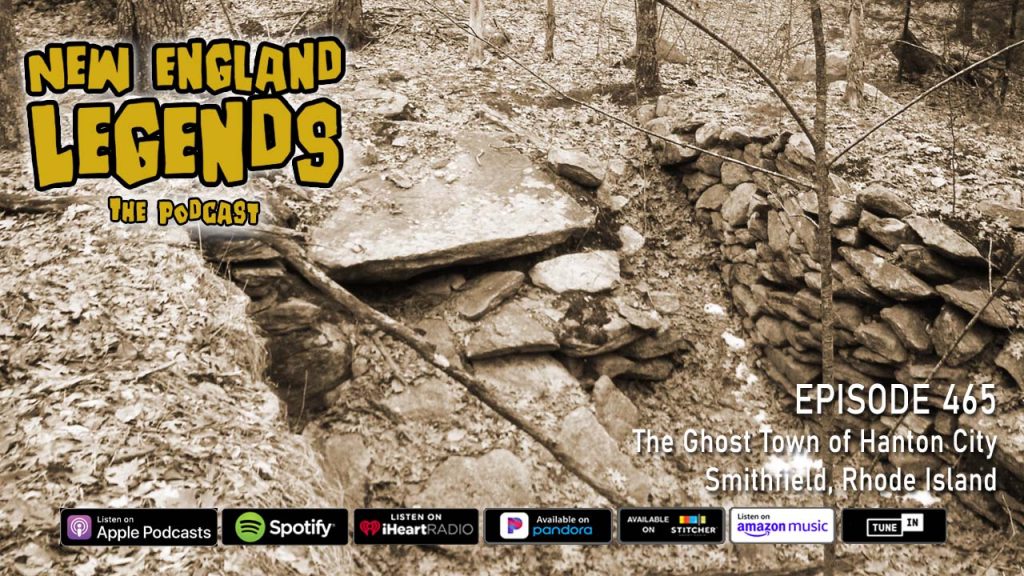
In Episode 465, Jeff Belanger and Ray Auger explore the ruins of Hanton City in the woods of Smithfield, Rhode Island. Never an incorporated city, town, or village, Hanton City rose up in the late 1600s far from the rest of the population, then was abandoned over a century later. What were they hiding from? Where did they go? Who lived here and why?
BECOME A LEGENDARY PATRON:
https://www.patreon.com/NewEnglandLegends
CREDITS:
Produced and hosted by: Jeff Belanger and Ray Auger
Edited by: Ray Auger
Theme Music by: John Judd
SUBSCRIBE TO THE PODCAST FOR FREE:
Apple Podcasts/iTunes | Spotify | Pandora | Amazon Podcasts | TuneIn | iHeartRadio
JOIN OUR SUPER-SECRET:
New England Legends Facebook Group
EPISODE TRANSCRIPT:
*A note on the text: Please forgive punctuation, spelling, and grammar mistakes. Like us, the transcripts ain’t perfect.
[HIKING IN THE WOODS]
RAY: We’re hiking in the woods of northern Smithfield, Rhode Island.
JEFF: We are.
RAY: We parked our car in a corporate office park, and started hiking a trail to the northeast of where we parked.
JEFF: Right. We’re looking for a ghost town in the woods.
RAY: Ooooh a ghost town. It’s always spooky to find the remains of a community, especially when it’s way out in the woods on its own.
JEFF: That’s the case with this one, Ray. We’re looking for old foundations and a cemetery.
RAY: I love it. We’ve been hiking a little over half a mile so far.
JEFF: Then we should be getting close. And if a ghost town isn’t scary enough for you, there’s currently a legal battle because an investment group is trying to put a data center on this land.
RAY: Talk about a ghost in the machine, right?
JEFF: Exactly. Ray, we’re hiking in the woods of Smithfield, Rhode Island, looking for the ruins of a ghost town called Hanton City.
[INTRO]
JEFF: I’m Jeff Belanger, and welcome to Episode 465 of the New England Legends podcast.
RAY: And I’m Ray Auger. Thanks for joining us on our mission to chronicle every legend in New England one story at a time. We love ghosts, monsters, aliens, UFOs, odd history, eccentrics, and all the other wicked strangeness that makes our region unique. We can’t do it without you! So please reach out to us anytime through our website.
JEFF: Our website is also the place to find links to our calendar of events. Dates to see Ray’s band the Pub Kings and dates to see me! My story tour is rolling. Some of my upcoming shows this month are happening in Loudon, New Hampshire, Lexington, Mass, Simsbury, Connecticut, Sunapee, New Hampshire, Millbury, Mass, Conway, New Hampshire, Voluntown, Connecticut, Dartmouth, Mass, and a many, many more.
RAY: We’ll go searching for the ghost town of Hanton City right after this word from our sponsor.
SPONSOR
[HIKING IN WOODS]
RAY: As we’re making our way through this trail in Smithfield, we’ve seen some stone walls, pretty typical New England.
JEFF: Yup. When colonists arrived here they found plenty of rocks. If they were going to work some kind of farm field, those rocks had to be moved. Back-breaking work. The stones formed many boundary walls, and we still see them all over today.
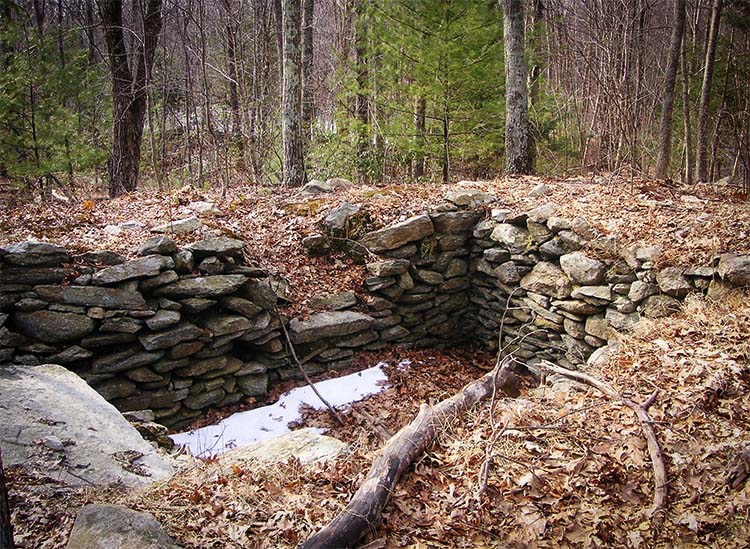
RAY: Okay, now we’re seeing some old house foundations. Basically stone walls stacked a little neater than the boundary walls, and in a rectangle — like a house foundation.
JEFF: Yes, clearly people lived here. The thing about Hanton City is it wasn’t listed on any official town maps. It’s not mentioned in many of the Smithfield town history books. But as you can see something was here. The fact that it’s missing from the records, that it’s way out here in the remote woods, and that no one talked about this place, only adds to the mystery and intrigue.
RAY: So who lived here?
JEFF: There are rumors. One is that the populations were ex-slaves and Native Americans who lived out here away from everyone else where they wouldn’t be bothered. Another story says this was the town poor farm, so the poor, widows, and destitute, lived out here on their own. Another rumor is that it was either British soldiers, or loyalists to the crown who formed their own community away from everyone else during the time of the American revolution when it became obvious we were breaking away from England.
RAY: No matter which version of the story you believe, clearly the folks out here wanted to be away from everyone.
JEFF: That’s true. Here’s the other strange thing about Hanton City.
RAY: Okay.
JEFF: The word “city.” It was never an incorporated town, let alone a city. Sometimes we hear about sections of incorporated towns being called “villages.” That fits. The village of Hanton within Smithfield. But that fact that we have this isolated clump of homes and farms, and then to call it a city, only adds to the mystery.
RAY: Could this be some kind of hyperbole from the locals? You know, build a shack and call it a castle. Build a village and call it a city?
JEFF: Maybe? But if you’re trying to isolate, and not draw attention to yourself, calling it a city is NOT the way to go.
RAY: Good point.
JEFF: Hanton City would not have been an easy place to live. Especially if you have a farm. The main central feature of the community is a swamp. Move up from the swamp and you’ve got hills and rocks.
RAY: That makes for tough farming.
JEFF: It does. Even the name of this place is a bit of a mystery.
RAY: I’d assume the Hanton family settled here at one point. That’s usually how villages and towns get their names.
JEFF: In the early days of this community – and we date those early days to the late 1600s – there are no town records of any official name to the area, but there was a family named Harrendeen, but it was also spelled Herenden, Hendon, and literally a dozen other ways. It’s believed the family name was actually Harrington, but it was misspelled and mislabeled enough times that it eventually became Hanton.
RAY: Back in the second half of the 1600s, this area would have still been part of Providence. Smithfield didn’t incorporate into its own town until the year 1731.
JEFF: And within the town of Smithfield are villages called: Greenville, Esmond, and Georgiaville. There are some smaller villages as well, but Hanton doesn’t make any of those lists either. Let’s keep moving.
[HIKING IN WOODS]
RAY: We’re passing more cellar holes as we hike through the trails.
JEFF: Trails that used to be roads for horses and wagons.
RAY: Now it’s mostly walking trails.
JEFF: Thanks to the work of the Historical Society of Smithfield, we know who lived where some of these ruins now lie. For example, we just passed the cellar hole of the Wilcox home.
[HIKING IN WOODS]
JEFF: And just up ahead this used to be a farm, with what’s left of the foundation of a house just up the hill behind it.
RAY: It’s tough to imagine what this town would have looked like back when people lived here.
[HIKING IN WOODS]
JEFF: Okay, we’re coming up to one of the sites I was looking forward to seeing.
RAY: We just passed the remains of the Daniel home site. We’re following a trail just up the hill.
JEFF: Okay… here it is.
RAY: Wow. Yeah, this doesn’t look like anything we’ve seen before.
JEFF: No, it’s different.
RAY: We’re looking at six upright stones in a small clump — maybe in a 20-foot square. The tallest standing stone is about three feet tall sticking out of the ground. The others are slightly smaller. Could this be a cemetery?
JEFF: Maybe, but the stones look almost haphazard, some face each other, some face different directions. Most cemeteries have some order to them, especially one this small. You’d expect to find the stones in some kind of row.
RAY: Right.
JEFF: There’s speculation that these stones could pre-date the colonists. Maybe it’s some kind of ancient alignment stones used by Native Americans. There are alignment stone sites all over New England. America’s Stonehenge in Salem, New Hampshire, is the most famous. But there are many others. It’s possible this is another one.
RAY: The Mystery deepens here at Hanton City.
JEFF: In the eastern section of the community, we find the remains of a small stone quarry.
[HIKING IN WOODS]
JEFF: But as we head further to the north, we see the remains of the Brown farm.
RAY: Okay, this looks like the biggest complex of stone walls and foundations we’ve seen so far in Hanton City.
JEFF: Definitely.
RAY: There’s an obvious cellar hole here in front of us. You can even see where the chimney used to be. This foundation is still in pretty good shape.
JEFF: Yes. The stones have been well-stacked into square corners. It’s lasted centuries longer than the wooden homes that sat on top of it. Should we head down to the basement?
RAY: Definitely. We’re walking through a break in the wall where there was clearly an entrance.
JEFF: And this was the basement of the Brown family’s home.
RAY: It’s wild to be standing in someone’s home centuries after the fact.
JEFF: It is. Give this a moment, Ray. This was someone’s home. (BEAT) Let’s keep moving. There’s more to see.
[HIKING IN WOODS]
RAY: There are some trees growing out of one of the other cellar holes. I imagine if those trees grow big enough they’ll eventually destroy the foundations. (BEAT) Huh… check this out over here.
[HIKING IN WOODS]
JEFF: Yeah, that’s strange.
RAY: It looks like two small square foundations. But they’re too small for a house or anything like that. Maybe some kind of animal pen?
JEFF: Maybe. Let’s head up the hill a little ways.
[HIKING IN WOODS]
RAY: Look at that. This is one of the reasons I love Rhode Island.
JEFF: And Rhode Island loves their dead.
RAY: We’re looking at an official Rhode Island historic cemetery marker. Site number 97.
JEFF: We know from the Rhode Island Historical Cemeteries database that there are two burials here. One from 1774, the other from 1781. We don’t know exactly who, their ages, or anything else, but we’re assuming they were members of the Brown family who owned this farm.
[HIKING IN WOODS]
RAY: This is a really cool site. All of it. Hanton City, or village, or whatever name you want to give it, is like walking around archeological ruins. But when and why did they leave?
JEFF: One theory is the men went off to fight in the American Revolution and never came back. While that sounds noble and romantic, it doesn’t hold much water. One of the other rumors that British loyalists settled here maybe hoping to wait it out until England took over again, doesn’t make a whole lot of sense because people were living here a century before the Revolutionary War. The hard truth is probably more boring than we’re used to.
RAY: What’s that?
JEFF: This land sucks for farming. Living here would be a lot harder than living just a few miles away on better land, or near towns and cities where there were more job opportunities. The world was changing. The industrial revolution in the second half of the 1700s meant you didn’t need to farm as an occupation. There was work to be had in more populated areas. Maybe living here was just too hard, and one by one, people left. Leaving behind their dead, their homes, and only a few sparse clues as to their history.
[HIKING IN WOODS]
RAY: We’re making our way back toward the industrial park on the western edge of the land that was once Hanton City.
JEFF: And now there’s a group trying to build a data center on this land.
RAY: Build a data center over the ruins of family burial plots and old historic foundations?
JEFF: That’s what developers would like to do.
RAY: I guess to some degree, progress can’t be stopped.
JEFF: True, but there’s plenty of downside to these data centers. They create a few construction jobs when they’re being put up, but they don’t employ many people once they are built. They also use a tremendous amount of electricity that can tax the local power grid, and a lot of water to cool all of those computers and servers.
RAY: Right, but they need to be built somewhere, right? At least no existing homes or businesses would be lost?
JEFF: True, and more data centers means more AI, which also brings a lot of good and bad. They call this proposed data center, the Hanton City Project.
RAY: If it does go through, I have no doubt they’ll introduce some ghosts in the machine.
[OUTTRO]
JEFF: No doubt. And that takes us to After the Legend, where we dig deeper into this week’s story and sometimes veer off course.
RAY: After the Legend is brought to you by our patreon patrons! Our patrons are the best. We can’t do what we do without them. They help us financially with all of the costs it takes to bring you two podcasts each week. For just $3 bucks per month, they get early ad-free access to new episodes, access to our entire archive of 465 episodes, plus bonus episodes and content that no one else gets to hear. To help the cause, please click over to patreon.com/newenglandlegends to sign up.
To see some pictures related to this week’s story, click on the link in our episode description, or go to our website and click on Episode 465.
Thanks to Jim Ignasher from the Historical Society of Smithfield. He did so much research on this place. While the actual haunting part is left to those who hike through, much of the history came from Jim.
Before you go, please make sure you subscribe to our podcast because it’s free and we don’t want you to miss a minute of the weirdness. We also deeply appreciate it when you help spread the word about us. You can do that by telling your friends, sharing our episodes on social media, or posting a review for us. It goes a long way.
We’d like to thank our sponsors, thank you to our patreon patrons, and our theme music is by John Judd.
Until next time remember… the bizarre is closer than you think.