
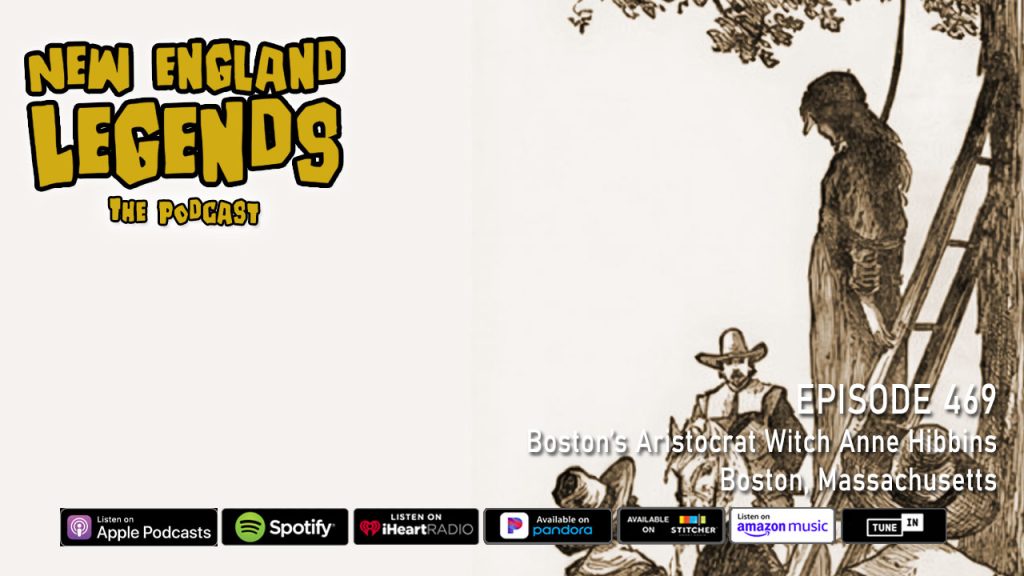
In Episode 469, Jeff Belanger and Ray Auger head to Boston Common to see ground-zero where the unusual story of an aristocrat accused of witchcraft came to an end in 1654. Anne Hibbins was wealthy and powerful. Her husband was assistant to the governor. But Hibbins was known for speaking her mind in public. After her husband’s death, there was no one to protect her, and soon whispers of her being a witch turned to shouts.
BECOME A LEGENDARY PATRON:
https://www.patreon.com/NewEnglandLegends
CREDITS:
Produced and hosted by: Jeff Belanger and Ray Auger
Edited by: Ray Auger
Theme Music by: John Judd
SUBSCRIBE TO THE PODCAST FOR FREE:
Apple Podcasts/iTunes | Spotify | Pandora | Amazon Podcasts | TuneIn | iHeartRadio
JOIN OUR SUPER-SECRET:
New England Legends Facebook Group

EPISODE TRANSCRIPT:
*A note on the text: Please forgive punctuation, spelling, and grammar mistakes. Like us, the transcripts ain’t perfect.
[LIGHT CROWD MURMER]
JEFF: Ray! Fancy seeing you curled up with a book at the Boston Public Library!
RAY: There’s a lot you don’t know about me, Jeff.
JEFF: That looks like a real book. Not even a comic book or graphic novel.
RAY: Yes, I’m caught up in the classics right now. Nathaniel Hawthorne’s The Scarlet Letter.
JEFF: Wow! I’m impressed. You decided to read this all on your own today?
RAY: Okay, fine. I peeked ahead at the notes on this week’s story. I started at chapter 2, where Hawthorne describes a witch named Old Mistress Hibbins.
JEFF: And there it is. You read a paragraph.
RAY: Most of a paragraph.
JEFF: Nathaniel Hawthorne was born in Salem, Massachusetts, in 1804—more than a century after the infamous witch trials of 1692. But clearly true stories of witches, the supernatural, and the trials they endured, inspired him.
RAY: So Hawthorne’s character, Mistress Hibbins was based on a real person?
JEFF: She was. And her story takes place decades before the Salem Witch trials. Ray, we’ve come to Boston, Massachusetts, to witness the trial of Anne Hibbins… a woman accused… of witchcraft.
[INTRO]
JEFF: I’m Jeff Belanger.
RAY: And I’m Ray Auger. Welcome to Episode 469 of the New England Legends podcast. Thanks for joining us on our mission to chronicle every legend in New England one story at a time. We’re always on the hunt for witches, ghosts, monsters, aliens, UFOs, and all of the other wicked strangeness that makes our region unique. So many of our story leads come from you. Like this one! Thanks to Rebecca for contacting us through our website.
JEFF: Also, on our website you’ll find dates for my on-going story tour, dates to see Ray’s band the Pub Kings, and a link to pick up the 2027 Haunted New England calendar by yours truly and photographer Frank Grace. Once they’re gone, they’re gone! Get them before the holidays for the spooky person in your life.
RAY: We’ll go searching for the Witch of Boston right after this word from our sponsor.
SPONSOR
[LIGHT CITY NOISES]
RAY: What brings us to Boston Common by the Frog Pond?
JEFF: Ray, this was ground zero for the story of Anne Hibbins who was accused of witchcraft.
RAY: We’ve covered many witch stories over the years here on New England Legends.
JEFF: We have.
RAY: And this particular witch isn’t even the first to inspire a book.
JEFF: Right! Back in Episode 261 we covered the story of Half-Hanged Mary Webster from Hadley, Massachusetts. She went on to inspire the hit book The Handmaid’s Tale by Margaret Atwood. And THAT went on to also become a hit television series.
RAY: That’s right.
JEFF: But Mary Webster, as with many of the witches we’ve covered over the years, was a poor woman. Not the case with Anne Hibbins of Boston.
RAY: Oh? She wasn’t poor and on the outskirts of society?
JEFF: Not poor at all, arguably very influential, but she would find herself on the outskirts of society. To find out what happened, let’s head back to the year 1654.
[TRANSITION]
RAY: It’s November of 1654 here in Boston, Massachusetts. Oliver Cromwell is the ruler of England, Scotland, and Ireland, since the monarchy was abolished five years ago. Major General Robert Sedgwick has just retuned from the Acadia region, having just captured some former French territory for the American colonies. And Richard Bellingham is currently governor of Massachusetts Bay Colony.
JEFF: The Puritans are in full control of the region. Their theocratic rule keeps everyone in line. Church and State are one. It’s not a bad time if you’re in charge and your beliefs align with the government. But right now, is an especially tough time for a local aristocrat named Anne Hibbins.
RAY: Anne’s husband, William Hibbins, was a wealthy merchant who served as Assistant Governor of Massachusetts, right up until his death back in May. William’s first wife was the sister of Governor Bellingham—in case there’s any confusion as to how he got the position. Since William’s death, Anne has been trying to keep her head down.
JEFF: Right. Anne Hibbins has a reputation for speaking her mind. And she’s had that reputation for years. Anne was born in Shropshire, England. She had three sons with her first husband, but her children stayed behind in England. She moved over to Boston with her second husband, William, who served various political roles in government in those early years. The couple were wealthy and powerful. Back in 1640, Anne first made waves after a dispute with a carpenter over his pricing and the quality of his work. Lawsuits were filed, Anne Hibbins won, but she couldn’t’ leave it alone. She took it upon herself to spread rumors about this carpenter far and wide. Soon other carpenters found themselves sticking up for their colleague, and a war of words ensues.
RAY: Eventually, Anne was brought before church elders who attempted to intervene and stop the war of words, but Anne refused to accept any blame or see anything wrong with what she was saying and doing. She believed the local carpenters were conspiring against her. The church excommunicated her for her lack of an apology. Because her husband sat in a powerful position, the community mostly laid off Anne. There’s not much anyone can do to people in power.
JEFF: But all that changed a few months ago when William Hibbins died. Now a widow, Anne is vulnerable. Yet, she’s still speaking her mind. She can’t help herself. When folks whispers about her, she shouts back.
[LOW WINTER WIND]
[WALKING ON STREET]
RAY: It’s now the winter of 1656. Anne Hibbins finds herself hauled before the church elders once again.
[DOOR OPENS / SLAMS SHUT]
RAY: The elders consider the matter of gossiping about the carpenter as unresolved.
JEFF: You’re kidding. It’s been 16 years since that happened.
RAY: They’re not kidding. It seems no one has let that go. Plus, Anne’s husband is no longer here to protect her.
[GAVEL BANGS ON BENCH]
RAY: The line of questioning gets uglier and uglier as Anne’s trial continues. At first, they accuse her of being too spirited in the way she conducts herself in public.
JEFF: So speaking her mind.
RAY: Right. Even the Puritans in Boston recognize that’s a flimsy charge. That’s when the questioning takes a darker tone.
PURITAN: You have Usurped authority!
JEFF: Soon, not just carpenters, but even neighbors are testifying against her character.
WHISPER: She’s a witch…
JEFF: And there it is. Once accused of witchcraft, the line of questioning turns even darker.
PURITAN: You have used witchcraft to murder your husband!
JEFF: After that accusation, there is no recovery for Anne. She can claim she didn’t murder her husband, and that she’s no witch, but that’s exactly what a witch would say.
[GAVEL BANGS ON BENCH]
RAY: The church elders and magistrate condemn Anne Hibbins to hang.
(PAUSE)
[BIRDS/OUTDOOR NOISES]
RAY: It’s June 19th. A crowd has gathered here in Boston to witness the hanging of Anne Hibbins. Earlier today a group of women from the church searched her body for signs of being a witch. A strange birthmark or growth that might confirm their suspicions. But they found nothing.
JEFF: This is too awful to watch. Anne Hibbins is stoic as they stand her up on the back of a wagon cart and place a rope around her neck.
[CROWD BOOS/GEERS]
JEFF: Some in the crowd taunt her or call her names. Other stand silently.
RAY: With the rope secured and her charges read to the crowd. The driver cracks his whip.
[WHIP SOUND]
RAY: And the horse pulls the wagon away.
[HORSE TROTS]
[ROPE SNAPS]
RAY: This is terrible. Anne’s body gives a few twitches… (PAUSE) and now she’s still. She’s buried in an unmarked grave nearby.
JEFF: As with any of these executions, there were supporters in the crowd as well. Minister John Wilson said Ann Hibbins was hanged for a witch only for having more wit than her neighbors. That wit cost her her life. And that brings us back to today.
[TRANSITION]
[LIGHT CITY NOISE]
JEFF: So we’re standing by the Frog Pond in Boston Common. It’s a shallow pool for kids and families to play in during the hot months. Being November, it’s closed until summer.
RAY: It’s kind of creepy to think that these kids play right near what was once the hanging tree.
JEFF: As we mentioned at the beginning, Nathaniel Hawthorne fictionalized Anne in his 1850 novel, The Scarlet Letter. In the story, the main character Hester Prynne, who had been convicted of adultery, came in regular contact with a witch named Mistress Hibbins who tries to get Prynne to sign the devil’s black book.
RAY: It’s amazing to me that women were seen as such second-class citizens back then.
JEFF: They were basically property, and the Puritanical government could do as they pleased—especially with a widow.
RAY: As we’ve seen in past stories we’ve explored, widowed women often become wards of the town. They community doesn’t like having to care for these women, the women don’t like it, and they use a witchy reputation to get more of the basics of what they need like food and wood to burn in their stoves.
JEFF: But what makes Anne Hibbins different is that she was a woman of wealth and status. All of the other cases we’ve explored involved poor women who had no means to defend themselves. No powerful political relatives or husbands to brush off any accusations. Anne Hibbins had that until her husband passed away. Her community had it in for her because she spoke her mind, and she paid for that with her life. Somewhere around us in Boston Common, she’s likely buried where countless people walk over her remains on their way to work, social functions, or passing on their way home. Maybe we should let THAT… haunt us.
[OUTTRO]
RAY: Maybe we should. And that takes us to After the Legends where we dig deeper into this week’s story and sometimes veer off course.
JEFF: After the Legend is brought to you by our patreon patrons! Thank you patrons for making all of this possible. Our patrons are the backbone of everything we do. It’s a private community of insiders who get early ad-free access to new episodes plus bonus episodes and content that no one else gets to hear. They also have access to our entire archive of shows and they get a unique RSS feed that they can paste into their favorite podcast player so they get all of the regular and bonus episodes right where they listen to all of their podcasts. It’s just $3 bucks per month, but it helps a lot! To sign up click over to patreon.com/newenglandlegends
To see some pictures related to this week’s story, click on the link in our episode description or go to our website and click on Episode 469.
Please hit that subscribe and share button wherever you get your podcasts. If you’re not ready to become a patron, you can still help by posting a review for us and telling your friends about our show. Share your favorite episodes on social media. The more people who listen, the more story leads that come in, and we keep our community growing.
We’d like to thank our sponsors, thank you to our patreon patrons, and our theme music is by John Judd.
Until next time remember… the bizarre is closer than you think.