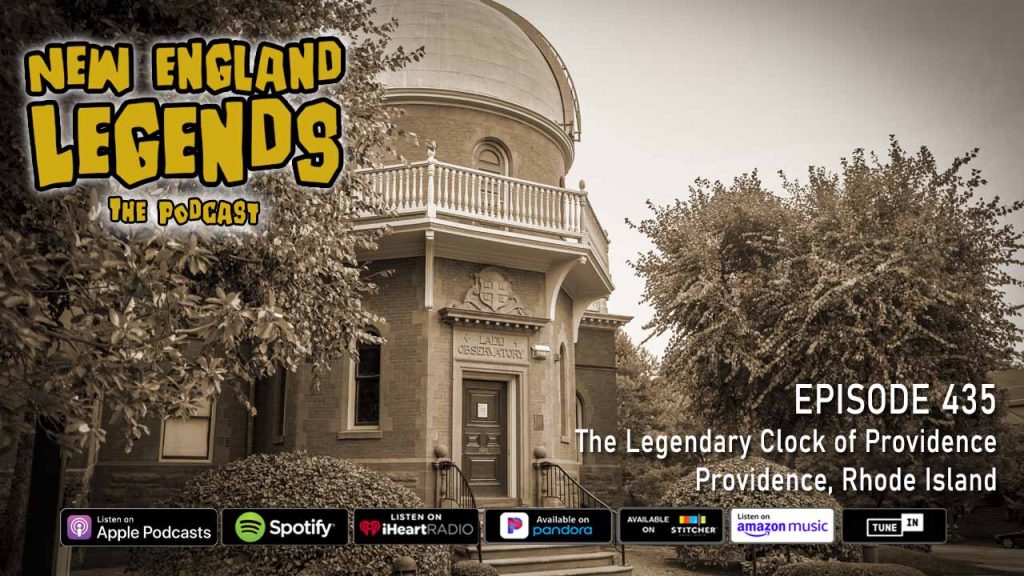
In Episode 435, Jeff Belanger and Ray Auger visit the legendary Ladd Observatory in Providence, Rhode Island, to explore its connection with a literary icon, possibly his ghost, and the method Providence used to keep time for 80 years.
BECOME A LEGENDARY PATRON:
https://www.patreon.com/NewEnglandLegends
CREDITS:
Produced and hosted by: Jeff Belanger and Ray Auger
Edited by: Ray Auger
Theme Music by: John Judd
SUBSCRIBE TO THE PODCAST FOR FREE:
Apple Podcasts/iTunes | Spotify | Pandora | Amazon Podcasts | TuneIn | iHeartRadio
JOIN OUR SUPER-SECRET:
New England Legends Facebook Group
EPISODE TRANSCRIPT:
*A note on the text: Please forgive punctuation, spelling, and grammar mistakes. Like us, the transcripts ain’t perfect.
[CITY TRAFFIC NOISES]
JEFF: Ray, what time you got?
RAY: Ahhh… let me check my phone… it’s 2:20 in the afternoon.
JEFF: Got it. Do you know where your phone gets its time from?
RAY: Actually, I do! So the U.S. Naval Observatory maintains about 100 atomic clocks. The United States and 90 other countries send their atomic clock data to the Bureau of Weights and Measures in France. The Bureau produces a weighted average of all of the data to create a time scale called Coordinated Universal Time or UTC. The U.S. Naval Observatory then adjusts their timescale for their master clock in Washington D.C. The Naval Observatory then beams the time to GPS satellites to correct their onboard clocks, and cell towers take their time from the GPS satellites.
JEFF: It’s almost like you had that prepared.
RAY: Almost! So when I tell you it’s now 2:21 in the afternoon, you can be sure that’s as accurate a time as you’re going to get.
JEFF: I believe you.
RAY: So what brings us to Providence, Rhode Island, today? I assume if we wanted to know the time, we could have figured that out from home?
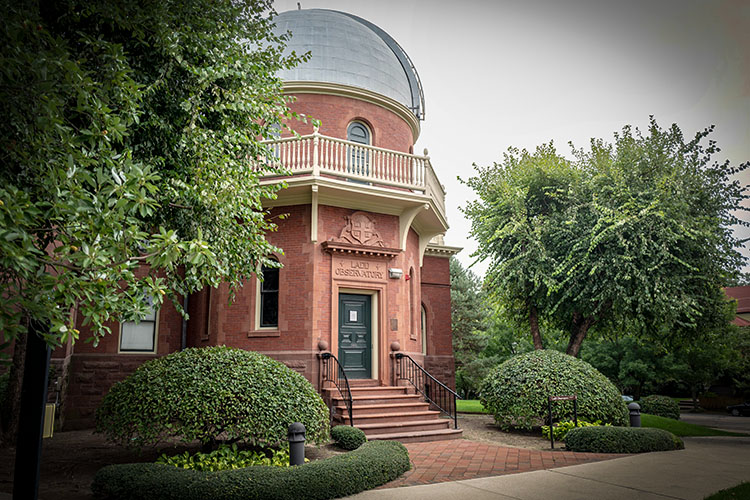
JEFF: That’s true. We’ve come to explore this iconic building perched on the highest point of the city.
RAY: Ohhhh I know this building. Very cool!
JEFF: For decades this was the building that Providence set its watch to. But that’s not the only notable thing associated with this place. There’s the connection to Brown University who owns the facility, a connection to a literary icon, possibly this author’s ghost, and over 130 years of local history. We’re in Providence to explore the legend of the Ladd Observatory.
[INTRO]
JEFF: Hey, I’m Jeff Belanger.
RAY: And I’m Ray Auger. Welcome to Episode 435 of the New England Legends podcast. Thanks for joining us on our mission to chronicle every ghost, monster, alien, roadside oddity, and strange bit of history we can uncover in the northeast. Did you know most of our story leads come from you? Reach out to us anytime through our website. We love hearing from you.
JEFF: We’ll explore the legends of the Ladd Observatory right after this word from our sponsor.
SPONSOR
RAY: I’ve known about the Ladd Observatory for a while now. It’s one of those buildings you just kind of hear about from time to time.
JEFF: Definitely.
RAY: I knew there was a telescope here, but I didn’t know this is where Providence got its official time.
JEFF: There’s a lot to this small building perched on a place once called Tintop Hill. They say it was called Tintop Hill because of all the tin cans that were dumped here.
RAY: Here’s a little more background on the Ladd Observatory. The building is named for Herbert Ladd who offered to fund its construction for Brown University in the spring of 1889. Construction began at the highest spot in Providence in May of 1890. At a cost of about $40,000—which would be about $1.4 million in today’s money, the Ladd Observatory was dedicated and opened for business on October 21, 1891.
JEFF: The telescope inside today is the same as when it opened. It’s got a 12-inch refractor. With this baby you can see some details on Saturn’s rings, Jupiter’s many atmospheric bands, and you can get a very good look at our moon.
RAY: There’s also a second telescope with a 3-inch meridian circle instrument that’s used for time-keeping.
JEFF: Okay, let’s get into timekeeping a little bit. It’s come a long way and for good reason. Ray, two hundred years ago, how did you know when it was noon?
RAY: I guess when the sun hits its highest point in the sky, it’s noon where you’re standing.
JEFF: Right. If you’ve got a sundial, that would let you know.
RAY: Sure.
JEFF: The problem is, when it’s solar high noon in Boston, it’s not solar high noon in New York.
RAY: I guess I never thought of that.
JEFF: There’s about a 12-13 minute difference between Boston and New York. Not a big deal two centuries ago. Even if you were traveling between the two cities, it look so long that it didn’t really matter. But then something big came along.
[OLD TRAIN WHISTLE]
RAY: The train?
JEFF: The train. Suddenly people could travel between Boston and New York in a lightning-quick 6-8 hours by rail when you account for stops and when the train had to wait for single-tracks and on-coming trains. In the 1880s, rail was expanding fast, interconnecting the entire nation. Knowing exactly what time it is got a lot more important for train schedules. In 1883, the railroad companies introduced time zones to help with the confusion between local solar times. And then, knowing what time it was is no longer a matter of convenience. Now there are train schedules, work schedules, appointments, and many other reasons for us to enslave ourselves to the clock.
RAY: It feels like the further we’ve progressed, the more that’s true. Now we have the atomic clocks of 90 nations feeding our satellites, the cell towers, and ultimately our phones. And we’re more frantic than ever.
JEFF: So true. For decades, the Ladd Observatory was the measure for how Providence kept its time. So let’s head back to 1903 and observe this iconic observatory.
[TRANSITION]
RAY: It’s September of 1903. Theodore Roosevelt is president of the United States, Lucius Garvin is the governor of Rhode Island, and “In the Good Old Summertime” by Sousa’s Band has been number one on the charts for weeks. Here on the East Side of Providence, Rhode Island, there’s a 13-year-old boy who is obsessed with space and the telescope located here at the Ladd Observatory.
JEFF: That 13-year-old boy’s name is Howard. Howard has been growing up on the East Side of Providence his whole life. He’s a curious kid. He’s already got a couple of telescopes at home. Lucky for Howard, the director of the Ladd Observatory is a family friend, so he’s able to spend a lot of time looking through the most powerful telescope in town.
RAY: Howard spends hours gazing at the heavens on clear Providence nights. He chronicles his experiences and observations through the telescope. His work is even published in the prestigious Rhode Island Journal of Astronomy!
JEFF: We should point out that The Rhode Island Journal of Astronomy is a three-by-four inch, hand-drawn and printed publication that’s reproduced by hectograph, a printing process that uses gelatin to transfer the ink. Howard is not just the chief correspondent for the journal, he’s also the publisher, designer, and distributor.
RAY: Enterprising kid.
JEFF: Enterprising kid. Most of the copies of the journal are purchased by his family members. That telescope opened up new worlds and possibilities to young Howard. He had to wonder what manner of creatures, creepies, and crawlies may reside on other planets.
[CLOCK TICKING / GRANDFATHER CLOCK CHIMES ONE]
RAY: One of the other main functions of the Ladd Observatory is time-keeping.
JEFF: Right. How does that work?
RAY: The smaller telescope in the observatory is called a transit telescope. What this telescope does is to measure the precise moment a celestial object like a star crosses a local meridian. It’s called Sidereal time. It’s based on the earth’s rate of rotation and the observer noting when a star crosses the imaginary meridian line. When you know that, you can figure out the precise time in Providence. The Ladd Observatory would then adjust their state of the art self-winding pendulum clock manufactured by R.I. Electric Protective Company right here in town. That clock is adjusted regularly to make sure it’s as accurate as possible. And then…
[TELEGRAPH BEEPS]
RAY: They have a second clock that automatically telegraphs out the precise time to folks in Providence. The first time signal was transmitted in September of 1893. Providence has been using the Ladd Observatory for time keeping ever since. Years pass, stars and comets go by, and Providence stays on track and on time thanks to observations made at the Ladd Observatory.
JEFF: By the way, that young boy named Howard who came here to observe the stars?
RAY: Yeah.
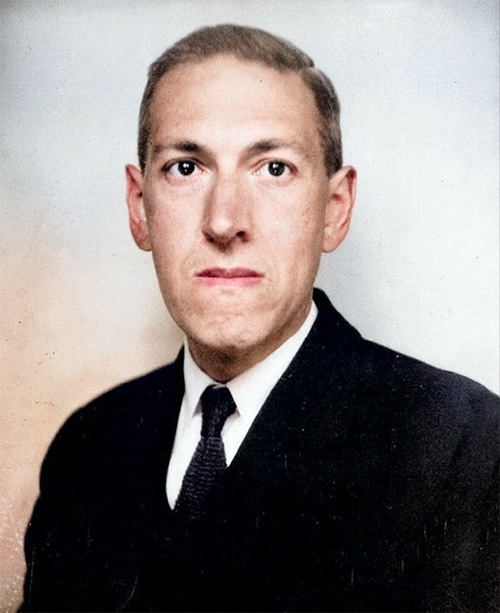
JEFF: His full name is Howard Phillips Lovecraft. Most of his writing about strange and scary things will be under the name: H.P. Lovecraft. And that brings us back to today.
[TRANSITION]
JEFF: The Ladd Observatory was added to the National Register of Historic Places in the year 2000. Today, it looks pretty much as it did when H.P. Lovecraft came here as a boy.
RAY: Speaking of Lovecraft, he had every intention to attend Brown University when he was growing up in the area, but after a nervous breakdown in high school, he dropped out of school entirely to focus writing what he called his quote “weird stories.”
JEFF: And that worked out okay…
RAY: That it did. For a while there’s been an annual H.P. Lovecraft event held at the Ladd Observatory every year.
JEFF: I know for a while my buddies, Keith and Carl Johnson used to run that. There would be public readings on the front lawn of the observatory. There’s even a rumor or two floating around that Lovecraft’s ghost haunts the building—though that could have more to do with him having a strong connection with the observatory than actual ghost sightings. Considering Lovecraft still has super fans out there, they love any connection to their favorite author.
RAY: Today the Ladd Observatory is still in use by Brown University. But it’s also open to the public on occasion. So you can also go inside and peak at the heavens.
JEFF: Not much has changed inside the Ladd Observatory since it opened. Some ropes and pulleys have been replaced, that state of the art self-winding pendulum clock manufactured by R.I. Electric Protective Company is still there, and everything inside still runs manually the way it always did.
RAY: And as far as the time-keeping goes, between 1906 and 1916, Brown University earned hundreds of dollars from local businesses and municipalities who subscribed to their time keeping service. The telegraph gave way to the wireless telegraph, which gave way to radio signals. Between 1893 and 1973 the Ladd Observatory was the official timekeeper for Providence, Rhode Island.
JEFF: That telescope has witnessed comets, quasars, distant galaxies, and inspired countless people who looked through that lens and wondered: what’s up there? The most famous stargazer being H.P. Lovecraft. Who knows what inspiration about the unknown struck young Howard and got him imagining what manner of creatures might be far out there near others stars as he gazed deep into space.
[OUTRO]
RAY: And that takes us to After the Legend where we take a deeper dive into this week’s story and sometimes veer off course.
JEFF: After the Legend is brought to you by our Patreon patrons! This is our familia, our crew, our founders of the feast. We can’t do this without them. All we ask is $3 bucks per month… that’s like buying me and Ray a gas station hot dog… that we’d have to split. For that, you get early ad-free access to new episodes plus bonus episodes and content that no one else gets to hear. To sign up, click over to patreon.com/newenglandlegends
To see some pictures related to this week’s story, click on the link in our episode description, or go to our website and click on Episode 435.
Please click subscribe wherever you get your podcasts. We have new episodes every Thursday, and From the Vault every Monday. We don’t want you to miss a minute of the weirdness. Also, if you post a review for us, or share our episodes with your friends, more people listen, and more story leads come in. Thanks for being part of our community.
We’d like to thank our sponsors, thank you to our patreon patrons, and our theme music is by John Judd.
Unti next time remember… stay legendary.