
In Episode 436, Jeff Belanger and Ray Auger head to Benson, Vermont, to trace the origins of Frozen Charlotte dolls. The tiny dolls were popular in the latter half of the nineteenth century and exist because of a song, based on a poem, based on a news story, based on a tragic and creepy winter legend.
BECOME A LEGENDARY PATRON:
https://www.patreon.com/NewEnglandLegends
CREDITS:
Produced and hosted by: Jeff Belanger and Ray Auger
Edited by: Ray Auger
Theme Music by: John Judd
SUBSCRIBE TO THE PODCAST FOR FREE:
Apple Podcasts/iTunes | Spotify | Pandora | Amazon Podcasts | TuneIn | iHeartRadio
JOIN OUR SUPER-SECRET:
New England Legends Facebook Group
EPISODE TRANSCRIPT:
*A note on the text: Please forgive punctuation, spelling, and grammar mistakes. Like us, the transcripts ain’t perfect.
[WINTER WIND AND STORM]
RAY: Jeff, this winter feels like it’s never going to end.
JEFF: I hear you! Blizzards, a cyclone bomb, a Nor’easter, this winter has been no joke.
RAY: It’s a frozen tundra out there. This has been one of the toughest winters I can ever remember.
JEFF: Even though we’ve come a long way in predicting the weather, snow removal, and so on, winter is still dangerous. If you get stuck outside without the right clothing or shelter… you could die.
RAY: We’ve covered plenty of stories about freezing to death in New England winters.
JEFF: We have… and I’m afraid we may need to add one more to that list.
RAY: Is that why we’ve come to Vermont?
JEFF: It is. We’ve come to Benson, Vermont, the birthplace of a blind folk singer named William Lorenzo Carter, who turned a tragic story into a song. We’ve come to Benson to search for “Frozen Charlotte.”
[INTRO]
JEFF: I’m Jeff Belanger. Welcome to Episode 436 of the New England Legends podcast.
RAY: And I’m Ray Auger, we’re glad to have you riding along with us as we chronicle every legend in New England, from ghosts to monsters, UFOs, roadside oddities, and all the other wicked strangeness that crosses our desk. If you’ve got a story you think we should check out, please reach out to us anytime through our website.
JEFF: We’ll go searching for Frozen Charlotte right after this word from our sponsor.
SPONSOR
JEFF: Okay, Ray… check out what I bought on eBay last week.
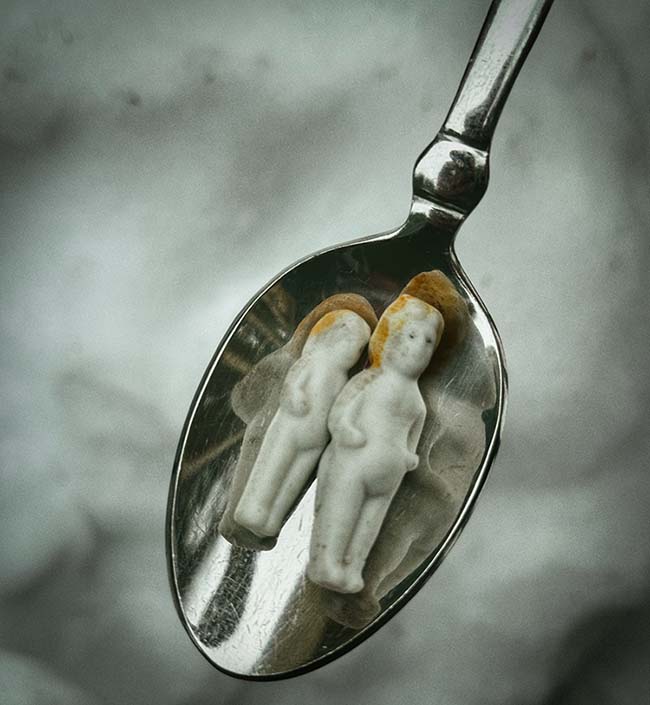
RAY: Okay… I’m holding two tiny stone dolls. One is maybe an inch and a half tall, the other maybe a quarter inch shorter than that. They’re both solid, white ceramic. We’re talking just a little bigger than say an aspirin capsule. They have little dots for eyes, and some yellow painted-on hair that’s mostly worn away. They don’t weigh much. And they look pretty old.
JEFF: They are old. They’re two stone bisque dolls that were manufactured in Germany in the second half of the 1800s. Dolls like these were pretty popular back then. And they’re called “Frozen Charlotte” dolls.
RAY: And we’re in Benson, Vermont, looking for Frozen Charlotte. I guess we just found her. Should I roll the closing credit now?
JEFF: Ha! Not quite yet. The doll is based on a song, which is based on a poem, which is based on a legend. I’m just pointing out how big this story got.
RAY: Even though these dolls are tiny. But I get your point.
JEFF: The doll is so small in part because people used to bake these dolls into cakes or hide them in puddings. Young children at a birthday or holiday would get a bowl of some sugary goodness, let’s say a piece of cake. A young girl may cut her fork into the cake and discover this little, dead, frozen doll, then squeal with delight because she now has a Frozen Charlotte.
RAY: Okay, that’s pretty strange.
JEFF: It is. And then the kids have to hear the story of Frozen Charlotte… a story we’ll get to soon. The reason we have these dolls today, traces its roots right through Benson, Vermont, and the vocal stylings of William Lorenzo Carter.
RAY: We don’t know a whole lot about Carter. We know he was born in the year 1813 here in Benson—just a bit northwest of Rutland, Vermont. The boy was born blind, but that didn’t stop him from becoming a poet and a musician. He regularly toured around the country performing.
JEFF: You never know when you’ll have a hit. To discover the backstory of these strange and macabre dolls as well as the poem that inspired them, let’s head back to the year 1839.
[TRANSITION]
RAY: It’s December 31st 1839. New Year’s Eve here in Vermont. For young Charlotte, it’s an especially exciting day because tonight she’s attending a New Year’s Even winter ball with her fiancé.
JEFF: There’s something about New Year’s Eve. Though it’s winter, and quite cold, it’s a romantic time when you have a sweetheart. The ball tonight is something all of the young people in the region are looking forward to.
[FIRE CRACKLING]
[LIGHT MURMURS OF PEOPLE IN THE BACKGROUND]
JEFF: Here at Charlotte’s house, everyone is busy. Mom is cooking in the kitchen. Dad is fetching more firewood for the hearth and trying to stay out of the way, and Charlotte is in her room looking over her ball gown. Everything has to be perfect for tonight.
RAY: Charlotte’s sister is helping. They both inspect every inch of the gown to make sure there are no loose threads. That every bead, every stitch is exactly as it should be. Charlotte has tried the dress on at least a dozen times in the past week. The fit is perfect. She wants to look great for her fiancé, Charles, of course… but if she’s honest, Charlotte intends to outshine all of the other young women in attendance tonight.
[HAIR BRISHING]
JEFF: It’s mid afternoon. Charlotte is completely focused on getting ready for tonight. Her sister helps with 100 hairbrush strokes on each side of her head.
RAY: Charlotte is applying her makeup. A little rouge. The right jewelry.
[RUSTLING FABRIC]
RAY: Charlotte is helped into her dress. Her sister is tying up the back now. (PAUSE) Wow… look at Charlotte. She looks beautiful.
JEFF: She does! Her dress has hints of white and blue. The perfect winter gown. There’s no doubt she’ll be the belle of the ball.
RAY: Charlotte is admiring herself in the full-length mirror in her room. She looks incredible and she knows it.
JEFF: Her sister is futzing with one of the shoulder straps.
[HAND SLAP]
JEFF: But Charlotte shoos her away. No one should mess with perfection.
[WALKING DOWN STAIRS]
RAY: Charlotte makes her grand entrance into her family’s parlor. Her family dotes compliments on her. Charlotte smirks back.
(PAUSE)
[WINTER WIND]
[HORSE GALLOPS UP]
RAY: Meanwhile, outside it’s frigid. It’s one of those cold, clear winter nights. The moon is full making the snow on the ground sparkle like billions of diamonds. The sleigh and chauffer have just arrived to bring Charlotte to the ball where she’ll meet her fiancé Charles.
[WHINY VOICE IN BACKGROUND]
JEFF: Charlotte’s mother is bringing out her daughter’s biggest winter coat.
CHARLOTTE: Uhhhm… no.
JEFF: But Charlotte refuses to wear it. The coat will cover her perfect dress and may wrinkle it.
[WHINY VOICE IN BACKGROUND]
JEFF: Charlotte’s mother next brings out some blankets to cover her daughter for the sleigh ride over.
CHARLOTTE: No!
JEFF: But Charlotte doesn’t want anything covering her beauty. She wants to arrive looking as perfect as she does right now.
RAY: Charlotte’s mother is upset. She knows how cold it is outside
[WINTER WIND UNDER BACKGROUND]
[HORSE TROTS OFF]
JEFF: And off she goes to the New Year’s Eve ball at an inn 10 miles away.
[HORSE TROTTING]
RAY: It’s really cold. The frigid night air combined with the wind from sitting in an open sleigh makes a windchill of who knows what temperature, but it HAS to be below zero.
JEFF: Charlotte is smiling, but shivering. Still, she’s determined to look perfect for her arrival at the ball.
RAY: The ride over to the ball is going to take about an hour by horse-drawn sleigh. The driver looks back to see Charlotte shivering. He offers his coat, but she shakes her head no… all the while her teeth are chattering away.
[SNAP OF REIGNS]
RAY: The driver cracks the reigns in the hopes of getting Charlotte to the inn a little faster so she can get out of the cold.
[HORSE TROTTING FOR A FEW SECONDS]
RAY: Finally, the sleigh pulls up to the front entrance of the ball.
[HORSE STOPS]
[LIGHT MURMURING CROWD]
JEFF: A footman has placed a block by side of the sleigh for the passenger to get out more easily… (PAUSE) The footman is waiting, but no passenger seems to be stirring. He steps up on the block to see if he can help the passenger. And that’s when he sees Charlotte. Her face frozen and blue in a ghastly smile. Charlotte is dead.
RAY: Charles, her fiancé runs to sleigh to see for himself. It’s awful. Charlotte is frozen. She’s gone.
[CROWD DIES DOWN]
RAY: Charlotte’s family are devastated. If only Charlotte would have listened to her mother and worn a coat, or covered up with a blanket. But now it’s too late. The frozen winter night air has claimed a victim.
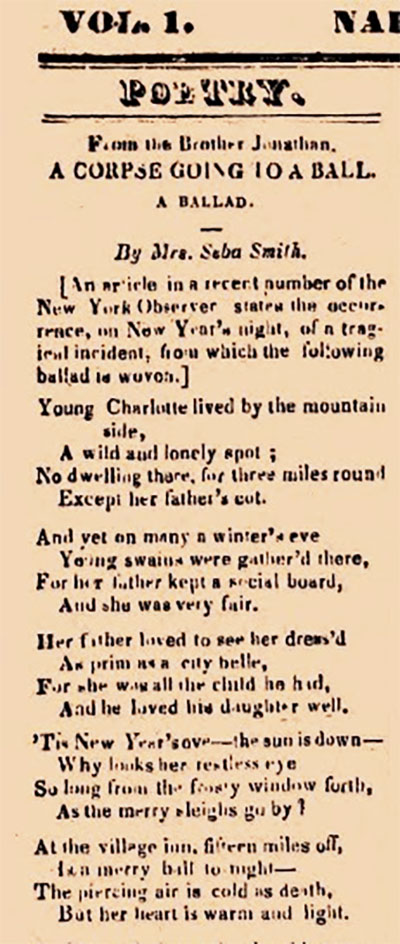
JEFF: As you can imagine, this tragic story makes it into various newspapers. It’s the kind of cautionary tale that gets picked up on the wire services. Eventually, the article makes its way to Maine, where a writer named Elizabeth Oakes Smith sees it for the first time. Smith is inspired. It’s now 1843, Smith pens a lengthy poem about what must have happened to young Charlotte. The poem is published in the newspaper, and soon, the poem also gets picked up in other newspapers. Go ahead and read a little bit to us, Ray.
RAY: Okay. [RUSTLES PAPER] It’s titled, “A Corpse Going to a Ball.”
Young Charlotte lived by the mountain side, in a wild and a lonely spot;
Not a dwelling house for five miles around, except her father’s cot.
Yet on many a winter’s eve, young swains would gather there
For her father kept a social board and she was very fair.
Skipping ahead…
Her gloves and bonnet being on, she jumped into the sleigh
And away they ride over the mountainside and o’er the hills away.
There’s merry music in the bells, As o’er the hills they go;
For the creaking rake the runners make, As they bite the frozen snow.
The poem then goes on to describe how she shivered and arrived at the ball frozen.
JEFF: The lengthy poem recounts the entire story. Being such a tragic and relatable tale, Mrs. Smith’s work is read far and wide. It even makes its way to Benson, Vermont, where it’s read to local folk singer William Lorenzo Carter.
RAY: Carter immediately sets himself to giving the poem a melody. He learns the words, takes a few liberties with switching a few things around, and pretty soon, he’s performing the song everywhere he goes.
JEFF: The song and poem go by various names like, “Fair Charlotte, “The Frozen Girl,” and “A Corpse Going to a Ball,” but soon becomes best known by the name “Frozen Charlotte.”
RAY: It doesn’t take long for people all over the northeast and even the Midwest to know the story and the song. Mothers sing it to their children as a reminder as to why they must bundle up on cold winter days.
JEFF: In the coming years, a manufacturer in Germany begins to make small Frozen Charlotte stone dolls. Those dolls are purchased far and wide. Mothers bake them into cakes or hide them in desserts. When their children find the doll, they squeal with delight and then ask to hear the story once again… the story about the stubborn girl who froze to death on her way to the ball because she didn’t listen to her mother. And that brings us back to today.
[TRANSITION]
RAY: And today we’re holding two of these antique dolls that are still around after all of these years.
JEFF: Some of theses dolls arrive in tiny metal coffins, some are a little bit larger—not by much. And some are a tiny bit smaller. A lot of these dolls made the rounds in the latter half of the 1800s.
RAY: I’ll say this about these tiny dolls. If you baked them into a cake and some kid takes a bite, at the very least they’re serious choking hazards!
JEFF: That’s true. Don’t try this at home or Frozen Charlotte may claim another victim.
RAY: The whole things is just so creepy. A young woman freezing to death unnecessarily back in the mid-1800s.
JEFF: She froze to death out of vanity. She’d rather look good than feel comfortable, or even be safe for that matter.
RAY: As we know all too well, even today, winter in New England can kill.
JEFF: And as we all know too well, we should listen to mother.
RAY: That’s true too.
JEFF: Will leave you with an old recording of the Frozen Charlotte ballad. This one is sung by Asa Davis of Norton, Vermont. Recorded July 21, 1946.
Young-Charlotte.mp3
[OUTTRO]
RAY: Such a tragic tale. And that takes us to After the Legend where we dive deeper into this week’s story and sometimes we veer off course.
JEFF: After the Legend is brought to you by our Patron patrons! These folks are the best, and we can’t do it without them. They help us finically with all of the costs it takes to bring you two stories each week. They have access to a special message board and RSS feed so they can get all of our regular episodes ad free, plus all of our bonus episodes in one place. To help the cause, please head over to patreon.com/newenglandlegends
And to see some pictures related to this week’s story, including my new Frozen Charlotte dolls, click on the link in our episode description, or go to our website and click on Episode 436.
If you’ve got a story you think we should check out, you can email us anytime through our website. Or just email us and say hi. We love hearing from you! We get so many story leads from you, so please keep them coming. Also, the more friends you tell about our show, the more people who listen and share their local legends, and we keep on growing.
We’d like to thank our sponsors, thank you to our patreon patrons, and our theme music is by John Judd.
Until next time remember… stay legendary.