
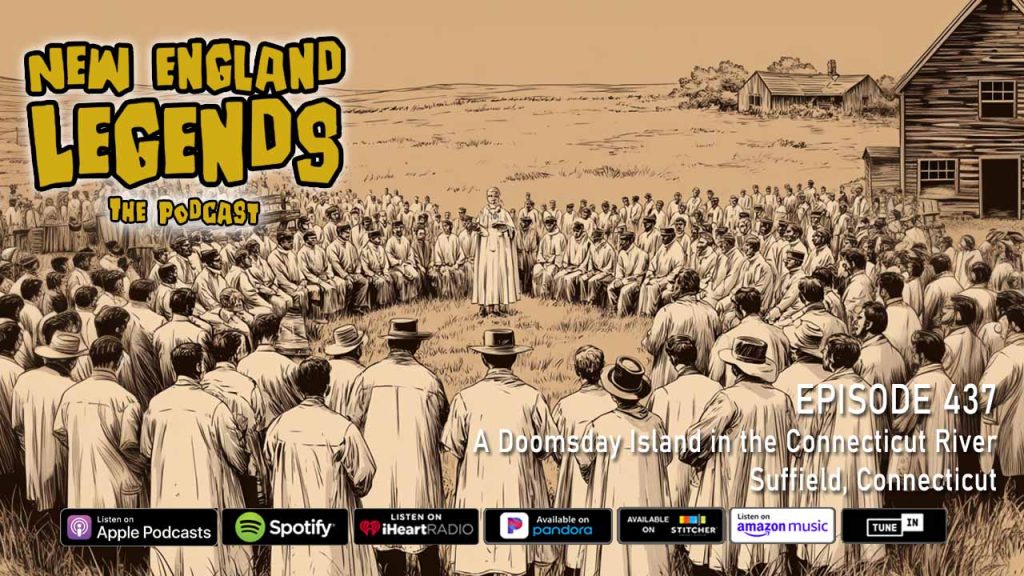
In Episode 437, Jeff Belanger and Ray Auger explore Kings Island in Suffield, Connecticut. The island was once home to DeWitt Terry, A Seventh Day Adventist elder who believed the second coming of Christ, and thus the end of times was going to occur November 5, 1873 (spoilers: he was wrong). Over 100 people once gathered on this island to await the end.
BECOME A LEGENDARY PATRON:
https://www.patreon.com/NewEnglandLegends
CREDITS:
Produced and hosted by: Jeff Belanger and Ray Auger
Edited by: Ray Auger
Theme Music by: John Judd
SUBSCRIBE TO THE PODCAST FOR FREE:
Apple Podcasts/iTunes | Spotify | Pandora | Amazon Podcasts | TuneIn | iHeartRadio
JOIN OUR SUPER-SECRET:
New England Legends Facebook Group
EPISODE TRANSCRIPT:
*A note on the text: Please forgive punctuation, spelling, and grammar mistakes. Like us, the transcripts ain’t perfect.
[RIVER RUNNING]
RAY: Jeff, Spring is just around the corner. It finally feels like maybe the winter is breaking up a bit. Not a bad day to be standing by the Connecticut River here in Suffield.
JEFF: Not a bad day at all. The snow is melting away. I wasn’t sure we’d survive that brutal winter.
RAY: It was looking bleak there for a while.
JEFF: Very bleak. Very, very bleak.
RAY: Yeah. I don’t like the way you said “very bleak.” Kind of ominous…
JEFF: I can’t help it. Sometimes it feels like we’re near the end.
RAY: I get that. The winter weather, the state of the world, it can get you down. (BEAT) Okay, now I’m depressed.
JEFF: Me too. But the good news is we’ve come to the right place for that.
RAY: How so?
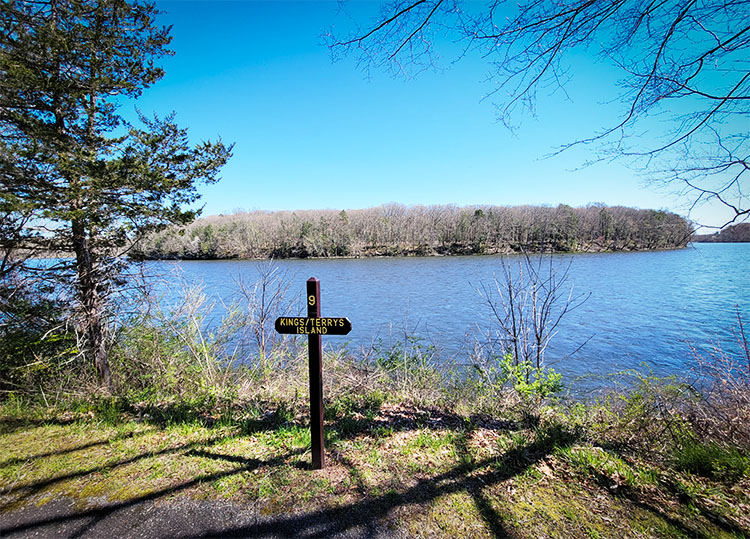
JEFF: You see that large island in the middle of the river?
RAY: I do.
JEFF: It’s called King’s Island. But it used to be known at Terry Island. But that’s not the point. We’ve come to Suffield, Connecticut, because it was on this island in front of us that a large group of people once gathered to await… the end of the world.
[INTRO]
JEFF: I’m Jeff Belanger.
RAY: And I’m Ray Auger. Welcome to Episode 437 of the New England Legends podcast. Thanks for joining us on our mission to chronicle every strange legend in New England one story at a time. Did you know most of our story leads come from you? This one did. Thanks to Tim Casey of the Suffield Connecticut Historical Society for tipping us off on this one. If you’ve got a story lead for us, contact us anytime through our website.
JEFF: We’ll explore King’s Island and the end of the world right after this word from our sponsor.
SPONSOR
[RIVER RUNNING]
RAY: So we’re standing on the banks of the Connecticut River in Suffield, looking at King’s Island.
JEFF: We are.
RAY: Kings Island is the largest island on the Connecticut River. It’s about 120 acres in size. It’s seen thousands of years of human activity. Native Americans used the island as a spring fishing spot for shad and salmon before the colonial period. There was a large sawmill on the island from 1787 to 1809. It was the perfect place for a sawmill because boats could bring the timber down the river, get the wood cut, then send the cut wood further down the river to Hartford and more points south. Sadly, the mill was washed away in a big flood in 1809.
JEFF: That must have been quite a flood to clear off an island this big.
RAY: No doubt. After that various families moved on the island and ran small farms. But today it’s a wildlife preserve. People can visit King’s Island by boat and walk the trails. But you’re saying this was once a gathering place for people waiting for the end of the world?
JEFF: It was!
RAY: We’ve covered doomsday and end of the world stories in the past.
JEFF: We have.
RAY: Not to ruin those stories… or this one before we even get started for that matter, but all of them proved to be wrong.
JEFF: That’s true. 100% without exception. All end of the world prophecies have been wrong. This one is no different.
RAY: Obviously because we’re still here.
JEFF: Obviously.
RAY: Obviously.
JEFF: We know of many end-of-the-world prophecies today whether it was Y2K, the Myan Calendar in 2012, there was even a viral TikTok prophecy from South Africa saying the world would end in October of 2025. All of them have been wrong. Yet some people still fall for them.
RAY: That is a head-scratcher. But you’re right. People still go in for some of these doomsday cults and ideas.
JEFF: It was true a century and a half ago too. Yet something about it calls to some folks. The stories are really fascinating. This one is no different. So let’s head back to the year 1873, and visit this Doomsday Island in the Connecticut River.
[TRANSITION]
RAY: It’s November 2nd of 1873 here in Suffield, Connecticut. Ulysses S. Grant is president of the United States, Charles Ingersoll is governor of Connecticut, and the region… really the whole country… is in financial trouble.
JEFF: How so?
RAY: After the Civil War ended in 1865, America prospered as it rebuilt and reunited. Those construction and infrastructure projects led to a lot of jobs and work. But recently, back in September, the Jay Cooke and Company collapsed. They had invested heavily in railroads, but were way overextended. It’s a period of widespread bank failures, business bankruptcies, and high unemployment. They’re already calling it the panic of 1873.
JEFF: So times are hard. When your job prospects are bad, when your bills are piling up and you can’t provide for yourself or your family, that’s a frightening time. But one person who is actually doing okay financially is DeWitt Clinton Terry, who runs a farm and business here on this large island in the Connecticut River.
RAY: Terry moved to the island nine years ago in 1864 with his wife and two daughters.
JEFF: He’s got his farm where he tends to a flock of turkeys among other animals, but he also runs a ferry service from the Suffield side of the river. For a small fee he’ll get you across the Connecticut River. Terry also runs a coffin-making business.
RAY: Well there’s a recession-proof business. I mean, people are always going to keep dying, right?
JEFF: That’s true. Though when times are tough you may not splurge on the deluxe coffins. Granny may have to get wrapped in a tarp and thrown in with the compost.
RAY: I guess there’s always ways to save a buck.
JEFF: Right. Though DeWitt Terry is also a coffin maker, the oddest thing about him are his religious beliefs. Terry is a spiritual leader in the Hartford and Springfield region for the Seventh Day Adventists, this group only formally organized two years ago in 1863. Most people knew them as the Millerites.
RAY: Riiiight. The Millerites. We’ve explored this group before. In 1831, William Miller believed that the second advent—or second coming of Jesus Christ would occur sometime between the years 1843 and 1844, this would bring on the final judgement and the end times.
JEFF: That’s the group.
RAY: By 1840, Miller had gained a lot of followers. Miller believed that the French Revolution which ended in 1799, was the start of the end times as predicted in the Biblical book of Daniel. Miller concluded that the second coming would happen between March 21, 1843 and March 21, 1844.
JEFF: Right. March 21, 1843 came and went without incident, but the faithful knew it could be any day within the next year, so they weren’t deterred. When March 21, 1844 also came without incident, people were upset.
RAY: Right, but then Miller claimed he reworked the math, and the new date was April 18, 1844. He was sure of it this time.
JEFF: Right, carry the one, divide by pi, the math can be tricky.
RAY: Exactly. When April 18th came and went, it became known as the Great Disappointment. The Millerites mostly disbanded after that, but a few of them, like DeWitt Terry, clung together believing the second advent would happen in their lifetime. That group went on to become the Seventh Day Adventists.
JEFF: I guess enough time had past since the Great Disappointment that the group could recruit once again.
RAY: Right, so people like DeWitt Terry and other members of his religion were always on the lookout for signs of the apocalypse. And they think they got their sign a couple of years ago in 1870. It was the Battle of Sedan during the Franco-Prussian War. This battle was a defining defeat for the French. Emperor Napoleon III was now prisoner. For Catholic France, big changes are coming. For Seventh Day Adventists like Terry, it looks like Rome and the Catholic Church had lost its last great defender. So using some math that no one can really explain all that well, it was believed the collapse of the papacy and thus the return of Christ would occur 3 years and 42 days from the start of the Battle of Sedan. Which would make the end of the world, November 5, 1873.
JEFF: That’s three days from now!
RAY: That’s right.
JEFF: That may explain why people have been gathering at Terry’s farm for the past two weeks.
RAY: Right now there’s about 60 people staying on or in DeWitt Terry’s farm. They’re sleeping in his house, in the barn, and any place they can make a bed.
JEFF: Throughout the days, Adventist elders are giving sermons about what’s to come in just a few days. They acknowledge the Millerites were wrong before. Everyone was disappointed, but this time… THIS TIME they have the date right. They’re certain.
[TURKEY GOBBLE GOBBLE]
RAY: Meanwhile, with sixty extra mouths to feed, Terry is burning through his livestock.
JEFF: But that doesn’t matter much. I mean the world is going to end in just a couple of days, so as long as there’s enough food to last until then.
RAY: Right.
JEFF: Right.
(PAUSE)
RAY: It’s now the evening of November 4th. The sun has set. The weather is clear.
[MURMURING CROWD FADES IN]
JEFF: The Adventists gathered here on Terry’s farm are now dressed in their ascension robes. They’re long white robes, almost like a priest’s frock.
RAY: Look at that… one of them is climbing a tree… I guess he wants to get to heaven first.
JEFF: Hey! It’s not a race! Is it? I mean, I guess it could be.
RAY: A few others have climbed on to Terry’s roof to await the second coming.
[NIGHT CRICKETS]
JEFF: Ray, what time you got?
RAY: Uhhhmmmm it’s just after midnight.
JEFF: November 5th.
RAY: That’s right. But to be fair, it could be anytime in the next 24 hours.
JEFF: That makes sense. I mean, it’s midnight here, but it’s hours later over in Rome. And hours earlier in California. Do we have a time zone on this end of times?
RAY: I don’t think so…. I guess we keep waiting.
[ROOSTER CROWS]
RAY: It’s daybreak, and it looks like everyone is still here. There’s close to 100 people wearing robes standing on DeWitt Terry’s land. They’re sure today is going to be the day.
JEFF: The hours slowly pass. Folks are watching for signs coming from the sky, from the sun, or from the ground. Some pray, some preach. Still, November 5th has been pretty uneventful so far.
RAY: Afternoon soon gives way into early evening. It’s a little chilly but the faithful are not deterred.
[NIGHT CRICKETS]
JEFF: The sun has set with still no sign of the end of the world. It’s now about 8 PM.
RAY: Many of these folks are tired. They’ve been up all night, and so far there’s been no sign of anything. You can tell some are feeling restless.
JEFF: Others are on their knees praying—showing their devout faith right up until the end.
JEFF: A few more hours pass. It’s after 11 PM. You can feel a shift in energy.
RAY: Yeah, everyone is on their feet again. We’re down to the final minutes of the day—and the world for that matter. It figures God would wait until the last possible minute to build the suspense.
(JEFF: Ray, what time you got now?
RAY: It’s about five minutes past midnight.
JEFF: We’re still here.
RAY: And so are all of these Seventh Day Adventists. A few of them are gently crying. Others are still praying. A few others are walking off to the barn or toward the house to get some sleep.
[ROOSTER CROWS]
RAY: It’s now the morning of November 6th and the world still hasn’t ended.
JEFF: Yeah, I see that.
RAY: Though many of the Adventists are packing up and heading home, others are convinced they should stay a few more days just in case the math was a little off.
JEFF: But DeWitt Terry has another problem.
RAY: What’s that?
JEFF: He doesn’t have much food left to feed everyone.
RAY: In Terry’s defense, when you expect the world to end, there’s no point in grocery shopping.
JEFF: There’s that. As if the world not ending isn’t bad enough, his flock of over 100 turkeys is pretty much gone.
RAY: Insult to injury, as they say.
JEFF: After a few more days pass, the rest of the Adventists leave, disappointed again, and DeWitt Terry and his family are left behind to try and rebuild. And that takes us back to today.
[TRANSITION]
JEFF: The Terry family continued to live on the island until 1895. His farm and business recovered, but his faith was shaken. Still, he remained in the religion until his death. The Terrys sold the island and farm in 1895 to move to Springfield, Massachusetts, to be closer to their daughter. Terry died in 1905.
RAY: At one point Connecticut Light and Power purchased the island with the intention of making it a hydroelectric facility, but that never happened. So today it’s a wildlife sanctuary. If you can get there by boat you can hike some of the trails on the island, you can even camp there. You can even sit on the shores and wait for the end of the world… but you may be waiting a very long time.
[OUTTRO]
JEFF: And that takes us to After the Legend, where we take a deeper dive into this week’s story and sometimes veer off course.
RAY: After the Legend is brought to you by or patreon patrons! We can’t do what we do without them. Our patrons help us financially with all of the many costs it takes to bring you two stories each week. All we’re asking for is $3 bucks per month—that’s like buying me and Jeff a gas station coffee—that we have to split. For that you get early ad free access to new episodes, plus bonus episodes and content that no one else gets to hear. Head over to patreon.com/newenglandlegends to sign up.
To see some pictures related to this week’s story, click on the link in our episode description, or go to our website and click on Episode 437.
If you love weird stories and legends, please make sure you subscribe to our podcast wherever you get your podcasts so you don’t miss a thing. You can also help the cause by posting a review for us and sharing our episodes with your friends. Post them to your social media, or just shout about us from your rooftops.
We’d like to thank our sponsors, thank you to our patreon patrons, and our theme music is by John Judd.
Until next time remember… stay legendary.