
In Episode 439, Jeff Belanger and Ray Auger explore the ruins of Livermore, New Hampshire. A once bustling little logging town nestled in the White Mountains of New Hampshire, this village has seen fire, plague, and flood before the citizens finally walked away. What’s left are the ruins and the ghosts.
BECOME A LEGENDARY PATRON:
https://www.patreon.com/NewEnglandLegends
CREDITS:
Produced and hosted by: Jeff Belanger and Ray Auger
Edited by: Ray Auger
Theme Music by: John Judd
SUBSCRIBE TO THE PODCAST FOR FREE:
Apple Podcasts/iTunes | Spotify | Pandora | Amazon Podcasts | TuneIn | iHeartRadio
JOIN OUR SUPER-SECRET:
New England Legends Facebook Group
EPISODE TRANSCRIPT:
*A note on the text: Please forgive punctuation, spelling, and grammar mistakes. Like us, the transcripts ain’t perfect.
[HIKING IN THE WOODS]
RAY: It’s still a bit chilly for a hike in the White Mountains of New Hampshire, Jeff.
JEFF: I get that. Though spring officially sprung a few days ago, the White Mountains take a few more weeks to get the memo.
RAY: That’s true. It takes a little longer to thaw up here. At least this walk is easy.
JEFF: We’re walking along Sawyer River Road off of Route 302 just south of Crawford Notch. There’s a gate that prevents you from driving down the old dirt road, so we had to park in the parking area next to the road and hoof it.
RAY: We’re following the Sawyer River, though to be fair, it looks more like a stream.
JEFF: Yeah, there’s not much too it. But if we follow this road we’ll find the ruins of a ghost town.
RAY: Ooooh… a ghost town way out here in the woods?
JEFF: That’s our objective, Ray. An old logging town that once boasted a population of almost 200 people, but now, it’s just some old foundations that sit under a cloud of tragic history. We’ve come to the White Mountains of New Hampshire to search for the ghost town of Livermore.
[INTRO]
JEFF: I’m Jeff Belanger, and welcome to Episode 439 of the New England Legends podcast.
RAY: And I’m Ray Auger, thanks for joining us on our mission to chronicle every legend in New England one story at a time. We’re always on the lookout for strange tales from the region. If you’ve got a story you think we should check out, please reach out to us anytime through our website. We love hearing from you. Also, our website is your place to see our interactive legend map so you can check out some of these legends for yourself, and we have a ton of events listed for Jeff’s ongoing story tour plus dates to see my band the Pub Kings.
JEFF: We’ll explore the ghost town of Livermore, New Hampshire, right after this word from our sponsor.
SPONSOR
[HIKING IN WOODS]
RAY: For centuries the White Mountains have called to people throughout New England and throughout the world, really.
JEFF: That’s true. These mountains are beautiful. They’re a wonder to see.
(PAUSE)
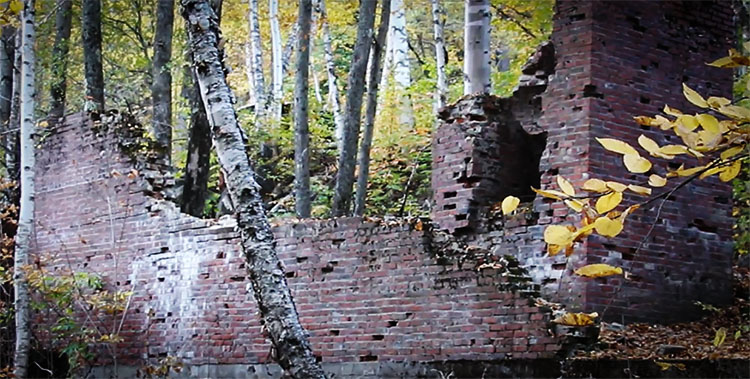
RAY: Okay, we’re coming up on some ruins of a building.
JEFF: Welcome to what’s left of Livermore, Ray.
RAY: There’s a brick structure that’s mostly in shambles now, but it was clearly a large building at one time.
JEFF: That’s what’s left of the old powerhouse.
RAY: There are cellar holes and other foundations down this stretch of former road too.
JEFF: It’s hard to believe this was once a town. There was a good stretch of time there where this region also called to people for the abundance of trees for logging. It was a big industry in these parts. Maybe not as big as say Maine, but still something.
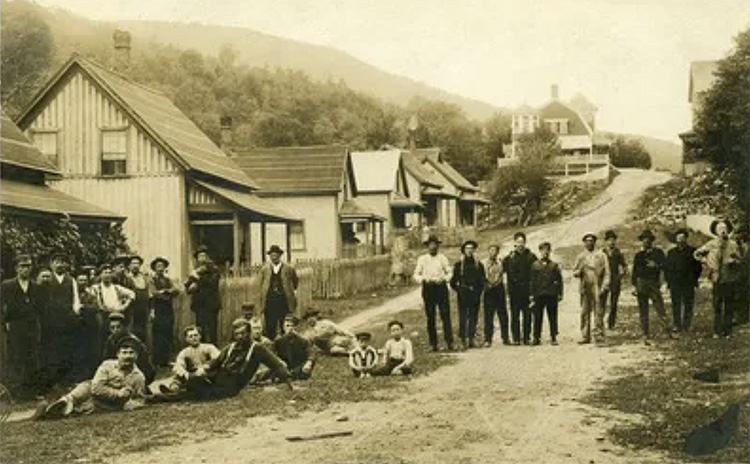
RAY: So the town of Livermore, was born as a logging town and incorporated in 1876 when the first lumber mill was approved. The Grafton Lumber Company was founded by brothers Charles and Daniel Saunders Jr. After their mill was built, the Sawyer River Railroad laid its tracks into town and now the lumber could move freely out to a country eager to build.
JEFF: By 1880, we’re talking the Gilded Age. America is expanding, building, and tourism is booming to the region. Though the winters are tough, living among all of this wild beauty is ideal for plenty of folks. Livermore, was on the rise.
RAY: And today, it’s a ghost town.
JEFF: What rises, often falls. To witness the downfall of Livermore, let’s head back to the year 1880.
[TRANSITION]
[SAWING SOUNDS]
RAY: It’s the summer of 1880 here in Livermore, New Hampshire. The population is 103 people. There are 18 homes, and two mills. At almost 64 square miles in size, Livermore feels like it’s on its own planet.
[TRAIN ROLLING BY]
JEFF: If not for the train that regularly comes through to haul away the cut timber, Livermore might be its own planet. Though it’s nestled in the middle of the beauty of the White Mountains, that doesn’t mean life here has been easy. Two years ago, a fire mostly destroyed one of the mills, but they quickly rebuilt. This year, though, there’s something even more dangerous than fire lurking in town.
RAY: What’s that?
JEFF: Smallpox. Maybe someone brought it in on the train, maybe someone from town caught it while visiting a neighboring town, but no matter what, it’s here now.
RAY: Smallpox is deadly and dangerous. It starts with a high fever, body aches and vomiting. Then a rash starts in the mouth and face then spreads throughout the body and limbs. Small pus-filled bumps form all over the body, until they burst, scab over, and eventually fall off as the virus runs its course over three to four weeks. Some people survive smallpox, but, about one out of three people who contract it don’t make it.
JEFF: Here in Livermore, a bunch of people have smallpox. Everyone is on edge. After a few months, six people in town die from it. While six may not sound like all that much, considering the population was 103, we’re talking about six percent of Livermore.
RAY: Still, Livermore has recovered from fire, they also recover from smallpox.
RAY: Time passes. Livermore gets it first post office in 1881, by 1885 there’s a school house with 28 students attending classes.
[SAWING]
JEFF: Meanwhile, life in this mill town continues. Babies are born, older people die. Telephone service comes in in 1898, the Saunders brothers divest their interest in the mills to other investors. But the timber keeps falling, and the mill keep sawing. In the year 1900, the population peaks at 191 people.
RAY: Between 1900 and 1910, the population falls by more than half to 64 people. Part of the problem is there’s less forest to log around here after decades of operations. The other problem is other parts of New England have bigger logging operations. At some point, Livermore is finding it tough to compete. Still, those who stay keep working.
[BUILDING ON FIRE]
JEFF: It’s 1920 when tragedy strikes Livermore again. Another fire destroys one of the mills.
[TRAIN RUMBLING THEN CRASHES]
JEFF: And to make things even worse, Livermore’s Railroad engine falls into the river.
RAY: Without the railroad engine, Livermore has to depend on other rails to move their lumber out of town. Profits are down. Opportunities are dwindling.
RAY: It’s November 2nd, 1927.
[THUNDER AND RAIN STARTS AND CONTINUES UNDER NEXT LINES]
RAY: When a massive rain storm hits New England.
JEFF: For four days the rains pound the region. The river swells, then floods.
[RAIN FADES OUT]
JEFF: By the time the rain passes and the flooding begins to recede, Livermore has lost its train tracks entirely.
RAY: And if you look at the forests all around us, there isn’t much left by way of trees for logging—another reason the flooding was so devastating here. With no rail, and no trees, Livermore has nothing to offer those who stay.
JEFF: By 1930, Livermore’s population stands at 23 people. In the coming years, that number dwindles to zero. And that brings us back to today.
[TRANSITION]
JEFF: According to the 1940 census, Livermore had four people living here that year. By 1950, it was zero. In 1951, the town disincorporated.
RAY: And then it’s a ghost town.
JEFF: Right… sort of.
RAY: What do you mean sort of?
JEFF: Okay, we know the population in 1950 was zero. Same in 1960, 1970, 1980, and 1990. Zero.
RAY: Okay….
JEFF: Then… in the 2000 census, the population of Livermore is listed as: Three.
RAY: Three people? Where? How?!
JEFF: Okay, thanks to some reporting by New Hampshire Public Radio, we know that Betty and Bob Shackford bought some parcels of land in Livermore. At some point they built a small red cabin using wood from the former mansion built by the Saunders Brothers. Bob Shackford died in 1992. Though the Forest Service tried to buy this land at one point, the Shackfords never sold. They wanted to keep the land and cabin in their family. It was a place for the kids and grandkids to come camp in the summer, play in the river, and explore the woods.
RAY: I can understand that. This is a beautiful spot nestled in the mountains.
JEFF: Here’s the funny part of the story. In 2000, Matt Shackford, the grandson of Betty and Rob Shackford, was visiting that cabin with his parents when the census taker came by and asked young Matt if anyone lived in the cabin. Matt replied, “I’d like to. And we do live here at least in the summer.” The census taker saw Matt and his two parents, then said, “Okay,” and left.
RAY: And that was it. Population three.
JEFF: Right.
RAY: So realistically, with the exception of this family’s cabin, Livermore was a ghost town after 1950.
JEFF: Right.
RAY: Today these cellar holes and partial foundations are the only testament left to Livermore.
JEFF: Livermore survived for about half a century, but it never really stood a chance. Once the forest was logged, once the fires hit, once the flood washed away the railroad, there was not much left to do except move on, or stay here and struggle. People lived here, they worked here, the fruits of their labor helped build New England and beyond, some died here, and maybe… some never left… making this ghost town…. Haunted.
[OUITTRO]
RAY: And that takes us to After the Legends where we take a deeper dive into this week’s story and sometimes veer off course.
JEFF: After the Legend is brought to you by our patreon patrons! If you like what we do, please thank a patron, because they’re the backbone of New England Legends. They help us financially with all of the expenses it takes to bring you two show each week! It takes a lot of time, effort, and money. So thank you patrons! Our patrons kick in just $3 bucks per month and for that they get early ad-free access to new episodes plus bonus episodes and content that no one else gets to hear. We hope you can join us at patreon.com/newenglandlegends.
To see some pictures of the Livermore, New Hampshire then and now click on the link in our episodes description, or go to our website and click on Episode 439.
Back in Episode 409 we did the story of the Ghost Town of Ricker Basin in Waterbury, Vermont. That 1927 flooding rain storm was even worse in Vermont. That storm gave us TWO ghost towns.
Do you subscribe to our podcast? You should! Because it’s free. We don’t want you to miss a thing. You can find us anywhere you get your podcasts. Also, check out Jeff’s latest book: Wicked Strange New England featuring the photography of Frank Grace. The full color book is filled with dozens of strange stories you love. You can get that anywhere books are sold, and there’s a link in our episode description, where you can also find a link to listen to me on Raydio!
We’d like to thank our sponsors, thank you so much to our patreon patrons, and our theme music is by John Judd.
Until next time remember… stay legendary.