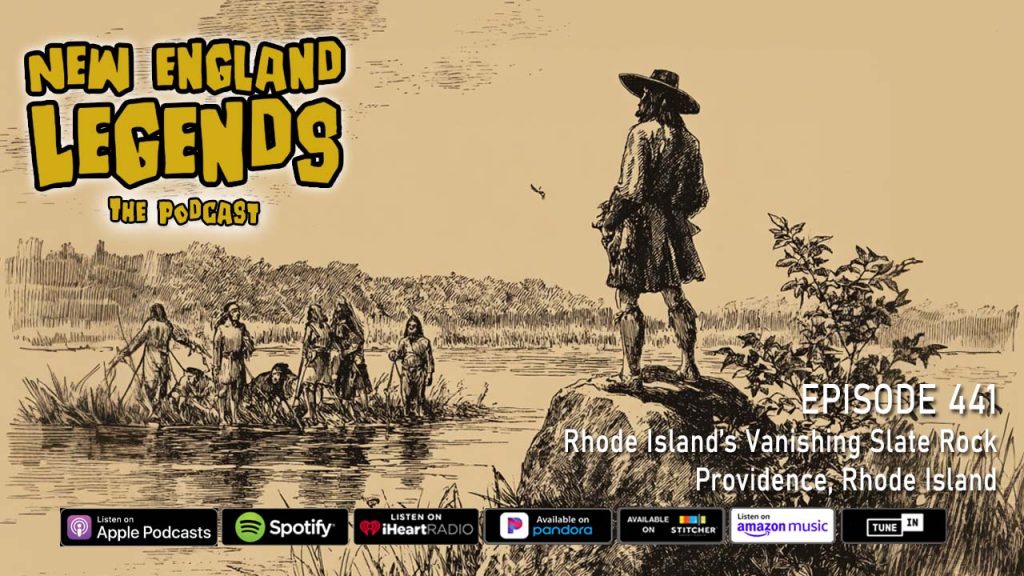
In Episode 441, Jeff Belanger and Ray Auger explore Roger Williams Square in Providence, Rhode Island, to investigate the disappearance of Slate Rock (also called What Cheer Rock) – a landmark that was on its way to becoming Rhode Island’s version of Plymouth Rock before it mysteriously vanished in 1877.
BECOME A LEGENDARY PATRON:
https://www.patreon.com/NewEnglandLegends
CREDITS:
Produced and hosted by: Jeff Belanger and Ray Auger
Edited by: Ray Auger
Theme Music by: John Judd
SUBSCRIBE TO THE PODCAST FOR FREE:
Apple Podcasts/iTunes | Spotify | Pandora | Amazon Podcasts | TuneIn | iHeartRadio
JOIN OUR SUPER-SECRET:
New England Legends Facebook Group
EPISODE TRANSCRIPT:
*A note on the text: Please forgive punctuation, spelling, and grammar mistakes. Like us, the transcripts ain’t perfect.
[MILD CITY NOISES]
RAY: So we’re standing in a small park at the corner of Roger Street and Williams Street.
JEFF: We are.
RAY: Those street names aren’t lost on me. Roger… Williams.
JEFF: Exactly. Roger Williams is the founder of Providence but also the state of Rhode Island. You can’t throw a rock in Providence without hitting something with his name on it.
RAY: We wouldn’t have to throw a rock very far here… we’re standing in Roger Williams Square. A quaint little park that’s about one square block in size.
JEFF: This is our destination, Ray. I know you’ve heard of Plymouth Rock in Massachusetts.
RAY: Of course! The nation’s number one most underwhelming national landmark. We covered that story way back in Episode 14.
JEFF: We did. Still, Plymouth IS a national landmark.
RAY: Right.
JEFF: This park commemorates the place that was once home to Slate Rock. The very rock where they say Roger Williams once stood when he founded this city and state almost three centuries ago.
RAY: Very cool! So where’s the rock?
JEFF: That’s the thing… centuries after the founding, after Rhode Islanders began to revere this rock the same way Plymouth revere’s its famous boulder… the rock… vanished.
[INTRO]
JEFF: I’m Jeff Belanger
RAY: And I’m Ray Auger. Welcome to Episode 441 of the New England Legends podcast. Thanks for joining us on our mission to chronicle every legend in New England one story at a time. We love stories of ghosts, monsters, aliens, eccentrics, odd history and all the other wicked strangeness that makes New England like no other place. Reach out to us anytime through our website with your story leads. We love hearing from you.
JEFF: We’ll go searching for this mysterious, historic, and vanishing rock right after this word from our sponsor.
SPONSOR
RAY: Okay, we’ve covered Roger Williams before.
JEFF: We have!
RAY: Way back in Episode 108 we covered the story of the apple tree that ate Roger Williams—it’s one of my all-time favorite episodes.
JEFF: Mine too! The Rhode Island Historical Society came to exhume the remains of Roger Williams to move him to a bigger memorial and found his remains had more or less been eaten by an old apple tree.
RAY: Amazing.
JEFF: It seems landmarks associated with and around Roger Williams meet unusual fates. This one is no different.
RAY: So let’s discuss a little more about the history of Roger Williams and the founding of Providence.
JEFF: Right. So Roger Williams was born in London, England, back in 1603. From a young age, Williams had an ear for language. He studied Latin, Hebrew, Greek, Dutch, and French. He first became a minister with the Church of England, but later became a Puritan. He was a separatist. He believed the Church of England was completely corrupt. In 1631, he sailed for Boston with some radical ideas.
RAY: What kind of radical ideas?
JEFF: He believed in religious freedom, he wanted to see fair dealings with the Native Americans, but his most radical idea was that there should be a separation between church and state.
RAY: Separation of church and state? That IS crazy!
JEFF: He saw that when the church becomes an extension of the government or if the government becomes an extension of the church, both sides are corrupted beyond repair. Eventually you won’t be the right flavor of the state religion, and then you have a theocracy where reason and law are thrown out the window and religious leaders can wield unchecked power.
RAY: As you can imagine, Roger Williams was NOT well received in Massachusetts Bay Colony.
JEFF: No he was not. Once he landed in Massachusetts, Williams befriended some of the Narragansett people. He learned their language and would author the first English to Narragansett dictionary. It was through this connection that Williams also learned that many English charters in the region didn’t compensate the Native Americans in any way. Williams didn’t care for that one bit. It was unjust and unfair.
RAY: Williams’s views didn’t win him a lot of friends in Boston. Williams was writing essays attacking the King of England and some of his charters. And the Puritans, who were squarely in charge of the government in Massachusetts, didn’t care for his ideas of separation of church and state.
JEFF: Roger Williams preached in Boston, Plymouth, and Salem, before each community kicked him out for his radical ideas and rabble rousing. By 1636, Massachusetts Bay Colony had enough of Roger Williams entirely, so they kicked him out.
RAY: But Williams was not deterred. He headed south to a place by a cove, near the river, and with a freshwater spring. There, some Narraganset people greeted him with the words, “What cheer, Netop,” which translates to “Hello, friend.”
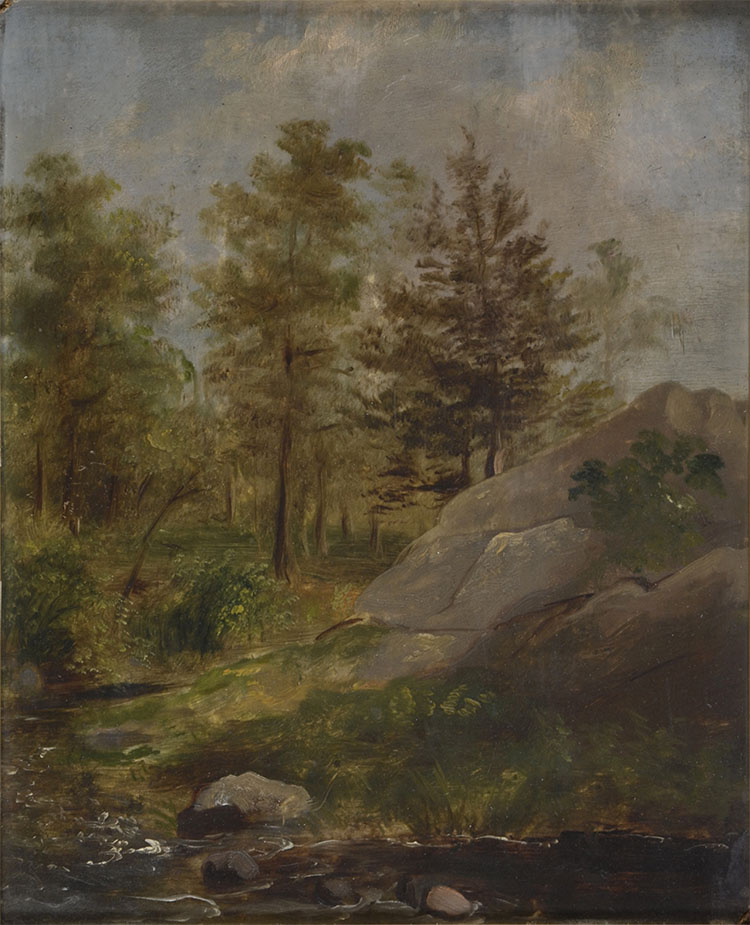
JEFF: That greeting happened just about right near where we’re standing in modern-day Roger Williams Square. Back then, there was a large boulder here that sat overlooking the Seekonk River.
RAY: After negotiating with the Narragansett, Roger Williams secured the land. Pretty soon, more disenfranchised Puritans came down because they liked Roger’s radical ideas. A village soon grew into a town. And Roger Williams proclaimed all glory for finding this new home should go to God. That’s when he came up with the perfect name for this new town. He called it… Providence.
JEFF: The giant rock was called Slate Rock or the “What Cheer” rock. It quickly became a landmark as the very spot where Providence was founded.
RAY: Roger Williams died in the winter of 1683 at 79 years of age. By the time of his death, his political cache was used up, he had lived to see the King Philip’s War wipe out most of his Native American friends, and by the time he was buried in his family plot on his property, not too many people took notice.
JEFF: But then something big happened about a century after his death. When the framers of the constitution were writing that hallowed document, folks in Rhode Island demanded some of their original charter ideas make it into the United States Constitution. Specifically, Roger Williams’s ideas of the separation of church and state. It’s fair to say Roger Williams is a founding father of the United States about a century before the others.
RAY: After the Constitution was ratified, the legend of Roger Williams began to grow once again, the folks back in Rhode Island were feeling proud of their founder. In March of 1860, the Rhode Island Historical Society decided to exhume Roger Williams and move his body from its resting place in the family plot, over to a grand monument befitting the founder of the state and arguably one of the founders of the United States. As we mentioned earlier, once he was dug up, they could see an apple tree root had more or less absorbed the body of Roger Williams. The historical society saved the tree root as well as some of the greasy dirt, and that had to be good enough.
JEFF: Okay, so we have the first Roger William mishap in 1860. To find out what happened to Slate Rock, let’s head back to the year 1877.
[TRANSITION]
RAY: It’s the spring of 1877 here in Providence, Rhode Island. Rutherford B. Hayes is president of the United States, and Henry Lippitt is the governor of Rhode Island. Recently the United States has been paralyzed by the Great Railroad strike. The nation is still trying to reconcile its reconstruction after the Civil War.
JEFF: The 1876 presidential election was disputed. The Compromise of 1877 allowed Hayes to be president in exchange for removing federal troops from the south, which ended reconstruction and allowing the south to usher in the Jim Crow era of segregation. But up here in Rhode Island, folks are feeling pride for their state and for their founder, Roger Williams.
RAY: About five years ago, some locals began talking about how Slate Rock—the place of Providence’s founding, was nearly covered by all of the washout from the hill above the rock.
JEFF: Years and years of natural erosion will do that.
RAY: Edward Lewis Peckham of Providence is trying to get locals to give Slate Rock its proper due. For Peckham, Slate Rock is just as significant as Plymouth Rock. Peckham explains that if the rock could be excavated, you’d see it’s covered in carved initials and even whole names of visitors who had left their marks on this important rock. So many of these folks were long deceased now. All of them were part of Providence history.
JEFF: Over the past five years, the ground has been swelling in Providence to make Slate Rock or “What Cheer” rock as others call it, a proper monument to where Roger Williams founded the city and ultimately the state. The city responded and said they would remove the sediment and make a proper shrine similar to Plymouth Rock in Massachusetts. Providence… started digging.
[DIG DIG DIG SHOVEL]
JEFF: Workers are excavating around the large rock. But the work is going slow.
RAY: We’re pretty close to the water. There’s a lot of silt and sand covering the rock. Digging it out is going to be a long process.
JEFF: Yeah it is.
RAY: That’s when city workers get an idea. (BEAT) Oh good, a few of them are carrying crates over to the rock.
JEFF: Is that…
RAY: Yup. Dynamite.
JEFF: Why dig when you can explode, right?
RAY: Exactly. They figure if they dig down a little ways, and stuff some dynamite in the sand and dirt, they can clear this place out in seconds.
[DIG DIG DIG]
RAY: They’re digging some deep holes right next to the rock.
JEFF: Okay, I can see them placing sticks of dynamite into the holes they dug. (BEAT) Hey, that’s a lot of sticks of dynamite.
RAY: Yeah, I guess they don’t want to have to do this twice.
JEFF: I’m no demolition expert, but that seems like a lot. I mean… doesn’t it?
RAY: Nahhhh… it’ll be fine!
JEFF: Okay… I guess it’s just sand and a big boulder, right? Okay… they’re still stuffing dynamite charges into the holes.
RAY: Keep going, boys! That’s a big rock and a lotta dirt!
JEFF: Yeah… Uhhhm. I still think it looks like a lot of dynamite.
RAY: Okay, let’s back away. They’re getting ready to ignite the fuse.
[MATCH LIGHTS / FUSE SIZZLES]
RAY: Okay, it’s burning!
JEFF: Yup… the charge is getting closer to the dynamite-filled holes….
[HUGE EXPLOSION]
JEFF/RAY: Woah! Look at that!
RAY: Yeahhhh! Woo hoo!
JEFF/RAY: (COUGHING)
JEFF: That was a pretty big explosion!
RAY: Okay… the smoke and debris are clearing out. (BEAT) Uhhhhmmm…
JEFF: Yeah.
RAY: Uuhhh… where’s Slate Rock?
JEFF: It’s gone! It’s been blasted into a million pieces.
RAY: There’s chunks of the rock lying all over the ground.
JEFF: There are broken pieces of Slate Rock all over the place. I can see some initials carved into some of the chunks. But yeah, that massive rock has been basically vaporized.
RAY: I guess that WAS too much dynamite. To be fair, blowing up giant rocks isn’t an exact science.
JEFF: Right. Not missing a beat, some locals begin to gather up chunks of the rock and selling them for anywhere between ten cents for smaller chunks to $2.50 for the larger ones.
RAY: Some artists even etch a likeness of Roger Williams into the rock chunks for sale. People are buying them up.
JEFF: Which makes us wonder how many of these are the actual rock and how many are rocks that look just like the real thing?
RAY: I guess we’ll never know. And that brings us back to today.
[TRANSITION]
RAY: With Slate Rock long gone, back in 1906, a pedestal monument with bronze plaques was placed in what is now called Roger Williams Square.
JEFF: Today the plaque reads: “BELOW THIS SPOT | THEN AT THE WATER’S EDGE | STOOD THE ROCK | ON WHICH | ACCORDING TO TRADITION | ROGER WILLIAMS | AN EXILE | FOR HIS DEVOTION TO | FREEDOM OF CONSCIENCE | LANDED | 1636”
RAY: A plaque on the other side reads quote: “AND HAVING OF A SENSE OF | GOD’S MERCIFUL PROVIDENCE | UNTO ME IN MY DISTRESS | CALLED THE PLACE PROVIDENCE | I DESIRED IT MIGHT BE FOR | A SHELTER FOR PERSONS | DISTRESSED FOR CONSCIENCE | ROGER WILLIAMS”
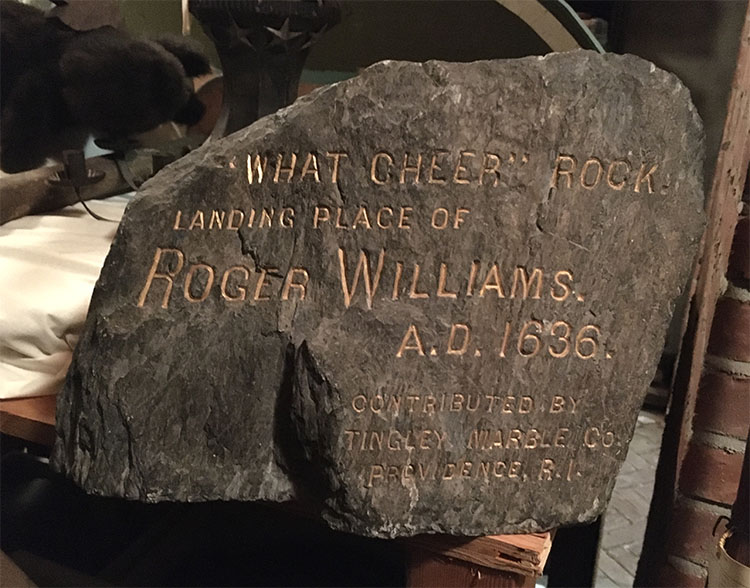
JEFF: Over at the Rhode Island Historical Society’s collection, they have an engraved piece of “What Cheer” rock contributed by the Tingley Marble Company.
RAY: Perfect! So you can see the rock while you’re checking out the tree root that ate Roger Williams.
JEFF: Exactly. Just like Plymouth Rock, we can’t promise the rock was all that important to the person it now commemorates. It would have been a logical meeting place for Roger Williams and the Narraganset people, but Roger Williams never made specific note of it. Still, this rock and this place did offer a connection back to Roger Williams. Care enough about a rock and a location, add in enough time… and it becomes sacred.
[OUTTRO]
RAY: And that takes us to After the Legend where we take a deeper dive into this week’s story and sometimes veer off course.
JEFF: After the Legend is brought to you by our Patreon Patrons! We’re so grateful to this group of insiders who help us financially with all of the costs it takes to bring you two podcasts each week. Please help us grow our community and help us take New England Legends even further. For just $3 bucks per month—that’s like buying me and Ray a gas station hot dog…. That we’d have to split. But it helps a lot if there’s enough of you. For that you’ll get early ad-free access to new episodes plus bonus episodes and content that no one else gets to hear. Just head over to Patreon.com/NewEnglandLegends to sign up.
JEFF: To see some pictures related to this week’s story, click on the link in our episode description, or go to our website and click on episode 441.
Hey, before we part until next time, please make sur you hit that subscribe button wherever you get your podcasts because it’s free! You can also give Jeff and I a follow on social media, and check out our website for video clips from the New England Legends television series that you can watch right now on Amazon Prime, plus a calendar to see dates for Jeff’s on going story tour and dates to see my band the Pub Kings.
We’d like to thank our sponsors, thank you to our patreon patrons, and our theme music is by John Judd.
Until next time remember… stay legendary.