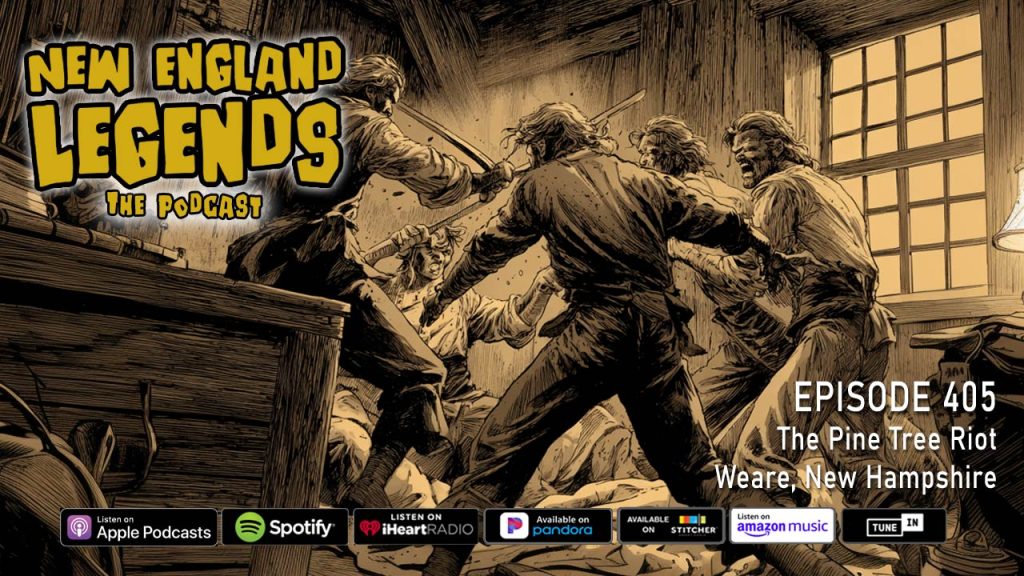
In Episode 405 Jeff Belanger and Ray Auger head to Weare, New Hampshire, to witness the Pine Tree Riot of 1772. Though few have heard of it, this unique act of violent revolt in the woods of New Hampshire led to the Boston Tea Party and eventually the American Revolution. We explore how it all went down.
BECOME A LEGENDARY PATRON:
https://www.patreon.com/NewEnglandLegends
CREDITS:
Produced and hosted by: Jeff Belanger and Ray Auger
Edited by: Ray Auger
Theme Music by: John Judd
SUBSCRIBE TO THE PODCAST FOR FREE:
Apple Podcasts/iTunes | Spotify | Pandora | Amazon Podcasts | TuneIn | iHeartRadio
JOIN OUR SUPER-SECRET:
New England Legends Facebook Group
EPISODE TRANSCRIPT:
*A note on the text: Please forgive punctuation, spelling, and grammar mistakes. Like us, the transcripts ain’t perfect.
[CARS DRIVING BY ON THE HIGHWAY]
JEFF: Ray, it’s a nice day for a stroll along Route 114 in southern, New Hampshire. The weather is good, I see some construction projects going on behind us.
RAY: Sure, but where are we going?
JEFF: Exactly.
RAY: Huh? No, I asked where are we going?
JEFF: And I said you’re correct.
RAY: What?!
JEFF: I’ve never been to What. Never even heard of it.
RAY: Where?!
JEFF: Right!
RAY: What?!
JEFF: There you go again. Don’t you know where we are?
RAY: I think I’m having déjà vu.
JEFF: Yeah. I get that.
RAY: We’ve been here before.
JEFF: Weare?
RAY: Yes. And I feel like we said this before.
JEFF: We may have.
RAY: Why are we back?
JEFF: Ray, we’ve returned to Weare, New Hampshire, to witness the Pine Tree Riot.
[INTRO]
JEFF: I’m Jeff Belanger.
RAY: And I’m Ray Auger. Welcome to Episode 405 of the New England Legends podcast. We’re on a mission to chronicle every legend in New England one story at a time, and we’re glad you’re riding along with us. We’re always on the hunt for odd history, ghosts, monsters, UFOs, roadside oddities, and all the wicked strange things that make New England like no other place. So many of our story leads come from you, so please reach out to us anytime through our website.
JEFF: We’ll explore the Pine Tree Riot right after this word from our sponsor.
SPONSOR
[CARS DRIVING BY ON HIGHWAY]
RAY: So a Pine Tree Riot?
JEFF: Right.
RAY: In Weare, New Hampshire?
JEFF: This was the place yes.
RAY: So the pine trees themselves rioted?
JEFF: No, the pine trees did what pine trees do. It was the people who rioted. And I can tell you… the riot was violent and is considered a significant stepping stone the founding of a new nation.
RAY: Really? This isn’t something I’ve heard about before.
JEFF: I don’t think a lot of people have. But many consider it the pre-cursor the Boston Tea Party.
RAY: So we’re talking revolutionary days.
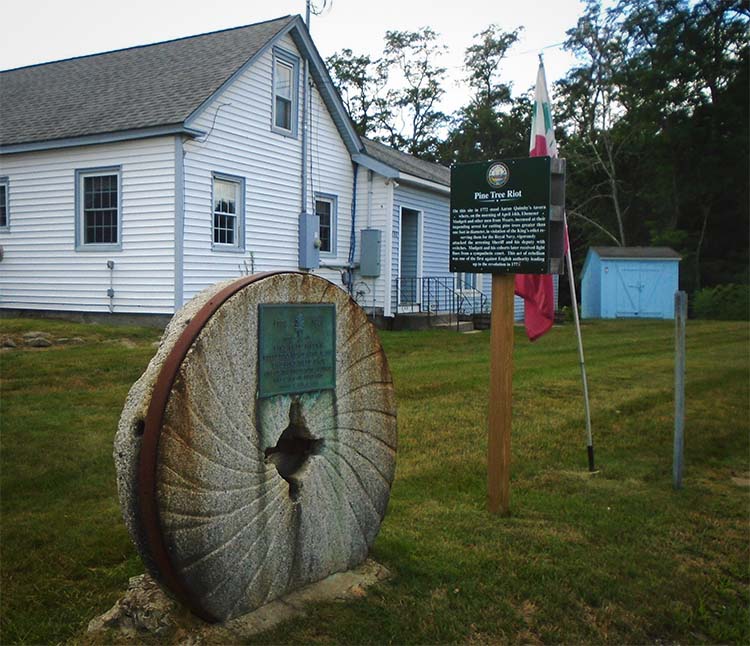
JEFF: We are. Right now we’re standing on the side of South Stark Highway, or Route 114 pretty close to the intersection with Knox Road in Weare. And our destination is right here.
RAY: Okay, I see an old round mill stone standing on its side facing the road. On it there’s a plaque that says: Site of Pine Tree Tavern, where took place April 14, 1772 The Pine Tree Riot. One of the first acts against the laws of England.
JEFF: The tavern is long gone. As is Quimby’s Inn which was also right here. Now there’s a commercial building that looks more like a house with this marker in their front yard just off the side of Route 114. To find out how it got here, let’s head back to 1772.
[TRANSITION]
RAY: It’s January of 1772 here in the young town of Weare. King George III is on the throne in England, and some of the colonists here in America are getting restless. The first cabin was built in town back in 1750, and since then Weare has grown.
JEFF: Some residents have cleared the land for farms. Others are working timber. The Americas are growing, and new houses and barns need wood. There’s a sawmill in town turning trees into usable lumber.
RAY: But for the King of England, New Hampshire’s forests contain something more valuable than gold… namely large white pine trees that are perfect for ship masts for the Royal Navy.
JEFF: England had already been deforested over a century ago, so if their navy is going to continue building ships and conquering far off lands, they need the right materials. Back in 1690, King William prohibited cutting down white pine trees over two feet in diameter, because those had to be reserved for the Royal Navy. In 1722, King George I lowered the diameter to one foot making even more trees off limits. He also established that you needed a license to cut any sort of tree for logging or otherwise, and put fines or even jail in place for those who broke the law. So what did the good resident of New Hampshire do in response to these laws regarding THEIR white pine trees?
RAY: What’s that?
[CHOP CHOP TREE FALLS]
JEFF: They ignored the law.
RAY: Makes sense. I mean… who would know?
JEFF: You’re mostly correct. Not too many government officials have the time to come inspect every tree in a sawmill. But then something changed five years ago.
RAY: What’s that?
JEFF: In 1767 John Wentworth was named governor of New Hampshire and appointed Surveyor of the King’s Woods. Wentworth saw the value of the trees and what they meant to the Royal Navy, so he deputized people throughout the land. He figured it was high time to enforce the existing laws. He even had a servant drive him around in his coach to personally inspect the mill yards for white pine.
RAY: I can’t imagine this is sitting well with the folks in New Hampshire.
JEFF: No it’s not. Now, before any settlers can clear lands for their homes or farms, the deputies come around and mark white pine trees that must be reserved for the King, and THEN ask the settlers for a license and fee for them to cut down the rest of the trees on their land.
RAY: You’re kidding.
JEFF: Nope. And neither is Governor Wentworth.
RAY: So if I settle some land and want to clear my fields of trees to build my home and barn, and have a clear field for livestock or growing food, I may not be able to if the tree is marked?
JEFF: That’s correct.
RAY: Ooooo That just burns my pantaloons!
JEFF: You’re not the only one. Illegally cut white pine can be seized, and the owner fined heavily, and even jailed.
RAY: I’m guessing that any moderately experienced deputy can look at a wood plank and make an educated guess as to whether it was taken illegally.
JEFF: They can. The thought is there should be no white pine out there in the market for building or otherwise, unless the logs are on their way to ship yard for one of his majesty’s boats.
RAY: Recently, a deputy surveyor of the King’s woods traveled to Oil Mill in the southern part of Weare and marked 270 trees he deemed worthy of a ship’s mast.
(LONG PAUSE)
[SPRING SOUNDS FADE IN]
JEFF: It’s now April, and a deputy surveyor has returned to Weare to inspect the King’s woods. He clearly sees many of his marked trees have been chopped down. A search of Weare and some of the nearby towns gave the deputy his answer. The trees were cut down despite the law and despite them being marked. So the deputy fined all of the loggers in question. Then men from the other towns hung their heads and begrudgingly paid their fines. But NOT the men from Weare. They refused and are labeled by the deputy as quote “Notorious offenders.”
RAY: For Governor Wentworth. This will not stand. County sheriff, Benjamin Whiting, Esquire of nearby Hollis, and his deputy John Quigley, Esquire of Francestown are charged with delivering warrants and making arrests in Weare.
[HORSES GALLOPING]
RAY: It’s April 13th when Whiting and Quigley ride into town.
JEFF: The sheriff’s main target is Ebenezer Mudgett. He was found to possess the most white pine timber.
[THUMPS ON DOOR]
[DOOR OPENS]
JEFF: After hearing the threats and accusations, Mudgett agrees to come into town the following day and pay his hefty fine.
RAY: The sheriff is satisfied with the news, plus, it’s getting late. He and his deputy ride for Quimby’s inn near the center of town to stay for the night.
JEFF: Ebenezer Mudgett is furious about the fine, but he also feels helpless.
RAY: Meanwhile, word of this injustice is ripping through town like a sharp axe through a soft tree. It would seem the people of Weare have had enough of this stupid law. This is THEIR land. If the king wants a few specific trees, that’s fine, but he can’t hold all of them, and then charge people a fee to take down other trees.
[NIGHT CRICKETS FADE IN]
JEFF: (WHISPERING) It’s just before dawn. There are over twenty men gathered here outside of Quimby’s Inn. They’ve painted their faces black as a disguise, and they’re armed with switches of sticks.
[DOOR SLOWLY CREAKS OPEN]
[SLOWLY CREAKING UP STAIRS]
JEFF: (WHISPERING) The group is about to storm into Sherriff Whiting’s room in the inn.
[WOODEN DOOR BREAKS IN]
[COMMOTION OF FIGHTING]
RAY: The Sherriff just grabbed for his pistols! (BEAT) Okay, a few of the men grabbed his hands and pinned him against the wall.
JEFF: I have no doubt a few of us would have been shot!
RAY: The mob have pulled the guns out of the room.
JEFF: Now a bunch of them have pinned the sheriff face down on the floor. They’ve ripped his shirt from his back.
[WHACK]
JEFF: The men are taking turns whipping the sheriff with their sticks.
[WHACK]
[MAN YELLS IN PAIN]
RAY: These men are enraged! They’re taking out every fine they’ve ever paid on this sheriff’s back.
[WHACK WHACK]
RAY: For many agonizing minutes, the men take turns whipping the sheriff’s back.
JEFF: The deputy in the room above doesn’t fair much better.
[WHACK]
JEFF: The mob are also beating the deputy with poles and switches.
[WHACK]
[MAN CRIES IN AGONY]
RAY: Outside, the mob doesn’t even spare the sheriff and deputy’s horses. They crop the horses’ ears and sheer their manes and tails.
[DOOR SLAMS]
RAY: The angry mob drag the bleeding sheriff and deputy outside, and shove them toward their horses.
[MOB YELLS AT THEM]
[SLOW HORSE TROT]
JEFF: The sheriff and deputy ride off toward Goffstown wishing they had never even heard of white pine trees.
RAY: The road they’re trotting down right now is called Mast Road, named for the very logs they came here to protect.
[MOB AND HORSES FADE OUT]
JEFF: Governor Wentworth can’t let this treasonous act go unpunished… but he also recognizing the precarious spot both he and the crown are in. You can only push your subjects so far. Once they resort to violence, you have to be careful. Is this a fluke, or merely the first blood drawn in something that could grow. In the end, eight men from Weare are brought before His Majesty’s Superior Court and charged with being rioters and disturbers of the peace and with “making an assault upon the body of Benjamin Whiting, Esq., Sheriff, and that they beat, wounded and evilly intreated him and other injuries did so that his life was despaired of.” They were also charged with going “against the peace of our Lord the King, his crown and dignity.” They were made to pay a light fine in the hopes this is the end of it. The judges understood how unjust the law is, so they made a statement with their mere 20 shilling fine.
RAY: Meanwhile, after new of the Pine Tree Riot spread, deputies in charge of marking white pine trees can’t help but look over their shoulder each time they ride through the forests of New Hampshire. And that brings us back to today.
[TRANSITION]
JEFF: Just a reminder that the Pine Tree Riot took place April 14, 1772. In 1773, England began enforcing a duty on tea, which led to the Boston Tea Party on December 16, 1773. Each was a stepping stone toward Revolutionary.
RAY: Why do you think we’ve all heard of the Boston Tea Party, but so few of us have heard about the Pine Tree Riot? Both seem like a significant moment in the American Revolution.
JEFF: In 1888, William Little published a book called History of Weare, New Hampshire, 1735 – 1888. In his book he addresses that very point. He said, and I quote, “The only reason why the Boston Tea Party is better known than our Pine Tree Riot is because they have better historians.”
RAY: Ha! I’m sure there’s a lot of truth to that.
JEFF: The Pine Tree Riot wasn’t the only rebellion in New Hampshire, either. There was a rebellion in Portsmouth in 1765 due to the Stamp Act, and an uprising from the 1764 Sugar Act. The American Revolution was never about one single issue, but a growing list of problems. In the end, the King of England learned the hard way there’s only so far you can push your subjects before they resort to violence, and then war. Sometimes something as simple as a tree can grow into a revolution.
[OUTTRO]
RAY: And that takes us to After the Legend where we take a deeper dive into this week’s story and sometimes veer off course.
JEFF: After the Legend is brought to you by our Patreon Patrons! They support us in everything we do, and we need them now more than ever. It takes a lot of time and money to bring you two podcasts each week, and our patrons make that happen. They kick in just $3 bucks per month, and for that they get early ad-free access to new episodes plus bonus episodes and content that no one else gets to hear. They also have access to our entire archive of shows. To sign up, you can click on the link in our episodes description or head to patreon.com/newenglandlegends.
To see some pictures of the Pine Tree Riot monument, you’ll also find that link in our episode description, or you can go to our website and click on Episode 405.
You know what to do. Before you leave us today, please make sure you subscribe to our podcast, because it’s free, post a review, because that helps others find us, and tell a friend or two about the show. YOU are where we get most of our story leads and how more people find out about our community. The more people who listen, the more leads that come in. We can’t do this without you.
We’d like to thank our sponsors, thank you to our patreon patrons, and our theme music is by John Judd.
Until next time remember… the bizarre is closer than you think.