

In Episode 408 Jeff Belanger and Ray Auger hike up Regicide Trail to Judges Cave in the woods of New Haven, Connecticut. Back in 1661, two judges on the lam from the King of England, hid inside these small caves. William Goffe and his father-in-law Edward Whalley were found guilty of signing the death warrant of King Charles I. King Charles II took that personally. Today the cave is a unique landmark.
BECOME A LEGENDARY PATRON:
https://www.patreon.com/NewEnglandLegends
CREDITS:
Produced and hosted by: Jeff Belanger and Ray Auger
Edited by: Ray Auger
Theme Music by: John Judd
SUBSCRIBE TO THE PODCAST FOR FREE:
Apple Podcasts/iTunes | Spotify | Pandora | Amazon Podcasts | TuneIn | iHeartRadio
JOIN OUR SUPER-SECRET:
New England Legends Facebook Group

EPISODE TRANSCRIPT:
*A note on the text: Please forgive punctuation, spelling, and grammar mistakes. Like us, the transcripts ain’t perfect.
[HIKING IN WOODS]
RAY: So we’re hiking the trails of West Rock Ridge State Park in New Haven.
JEFF: We are. It’s a pretty area with lots of woods, an impressive cliff face and an amazing view below, there’s ponds along the trail. It’s a great spot in nature that’s pretty close to the city of New Haven. We’re just a bit north of the city.
RAY: We’re also kind of close to the Wilbur Cross Parkway. You can barely hear it in the distance.
JEFF: We don’t have much further to go. Can you check the map to see what trail we’re on?
[SHUFFLING PAPER]
RAY: Sure. Okay… huh… it says we’re on Regicide Trail.
JEFF: (LAUGHING)
RAY: Isn’t regicide the murder of a king?
JEFF: Yeah, that IS the definition.
RAY: And they’ve named the trail that. I should mention I’m looking at the official park map. This isn’t some nickname.
JEFF: That’s true. And here’s our destination up ahead.
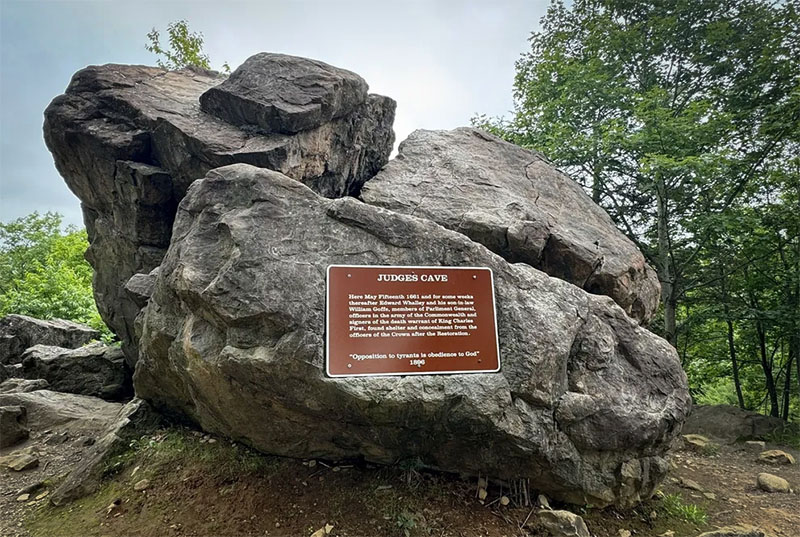
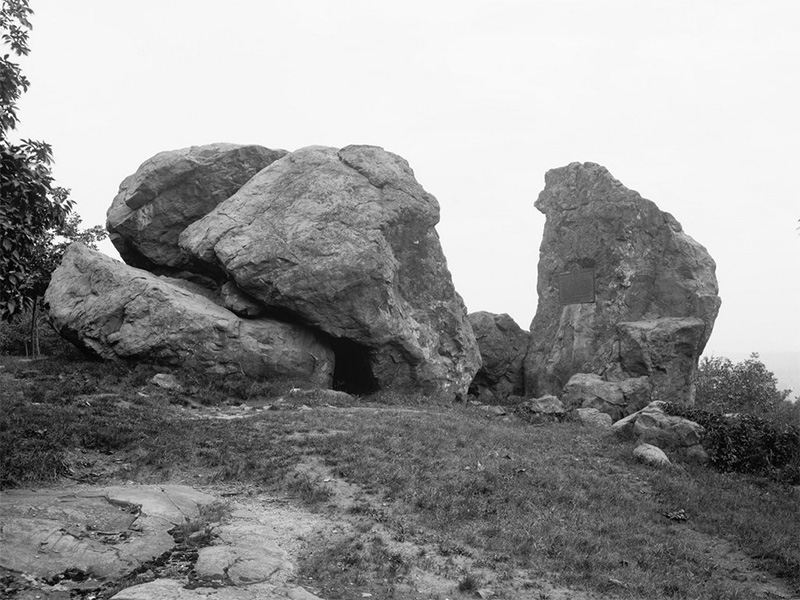
RAY: Wow. We’re looking at a giant bolder that’s cracked in a few places. It looks almost like you can go into a small cave inside.
JEFF: You can. We’re here in New Haven, Connecticut, to explore Judge’s Cave… it’s called that because this rough outcrop of rocks was once home to a couple of judges who were found guilty of regicide.
[INTRO]
JEFF: I’m Jeff Belanger.
RAY: And I’m Ray Auger. Welcome to Episode 408 of the New England Legends podcast. Thank you for joining us on our mission to chronicle every legend in New England one story at a time. From the wicked strange, to the haunted, to the just plain weird, we love it all. Also, if you’ve had a strange experience in New England, we want to hear from you! Please email us through our website and tell us a little about it. We might like to interview you for a future podcast episode. Whether you’ve had a ghost encounter, UFO sighting, monster experience, or something else, please let us know.
JEFF: We’ll explore this mysterious cave right after this word from our sponsor.
SPONSOR
[WALKING IN WOODS]
RAY: Now that we’re walking around this giant, broken boulder in New Haven, I can see there are gaps and space to crawl inside.
JEFF: There are. Let’s get a little closer.
[WALKING IN WOODS]
RAY: Okay, calling this a cave doesn’t seem quite right.
JEFF: I get that.
RAY: It’s more like a collection of giant broken rocks. I can see some space where we can squeeze in.
[ROCKS SCRAPING]
RAY: Yeah, it’s a tight fit, but there’s some room to move around a little in here.
JEFF: Yeah, but not much. It can offer shelter if there’s literally nowhere else to go. But it’s not ideal. Still, this was the place long ago where two men took shelter because they were being hunted for a role they played in the execution of a king.
RAY: Yikes! That would explain the name Regicide Trail.
JEFF: It would. And it would also explain why there’s now an historic marker on this rock. To find out how it got here, let’s head back to the year 1661.
[TRANSITION]
RAY: It’s May of 1661 here in New Haven Colony. King Charles II is on the throne in England. He’s been king for about a year now, ever since the monarchy was officially restored, but his official coronation didn’t take place until just a few weeks ago at Westminster Abbey. It’s a strange time for England and her colonies. Though the news of the new king is big, for most people in New Haven and its neighbor Connecticut Colony, they’re still trying to build a life here. News from England feels like a million miles away.
JEFF: That makes sense. Colonists here in the New Haven area have bigger things to worry about. However, this is an historic time for the country. Back in 1642, England began a lengthy period of Civil War. Parliament felt King Charles I had too much power. They tried to create laws that would limit what the King can and can’t do. King Charles believed in the divine right of kings. There’s more to it, of course. Catholicism was seen as a threat, and the Church of England enjoyed having its power, but the gist is: Many people rallied around parliament, many others rallied around King Charles I, and they fought.
RAY: Yeah, it was a messy time for sure.
JEFF: By 1949, 53 commissioners—including judges, military officers, and other prominent people signed the death warrant against King Charles I, calling him a quote, “tyrant, traitor, murderer, and public enemy.” The king was beheaded January 30, 1649. After that, the Puritans under Oliver Cromwell were firmly in charge of England and her colonies.
RAY: After Cromwell died in 1558, there was turmoil once again, until last year when King Charles’s son, King Charles II, returned from exile and was installed as king once again.
JEFF: In an effort to reunite the country, King Charles II forgave everyone involved in the Civil War… everyone except the 59 men who signed his father’s death warrant. For Charles, this was deeply personal. The king wanted them all tracked down, arrested, and executed.
RAY: That must have been rough for those on the list.
JEFF: Very rough. For over a year now, officials have been hunting down all of them. Some were found easily and soon faced torture and public execution. Some on the list had already died from various causes, but that didn’t matter to King Charles II. If they had already died, he had their bodies dug up, publicly executed… if you can do such a thing to a corpse. And then beheaded.
RAY: So if you knew your name was on the list, your days were numbered.
JEFF: No question. Some stood tall to face their charges… and their doom… others ran for it. Two of those people who ran for it are William Goffe and his father-in-law Edward Whalley. Both military officers who fought on the side of parliament and who signed the death warrant. The men sailed for Boston in July of 1660. Goffe and Whalley lived openly in the village of Cambridge near Boston for a little while. They were welcomed by their puritan neighbors who were no fans of the king. But once news of the Indemnity and Oblivion Act reached the Boston area, Goffe and Whalley knew they were in trouble. They were wanted men. It’s a matter of time before royal officials find them and punish them. AND punish any citizens who aids them in any way. Goffe and Whalley had to get out of town.
RAY: So back in late February of this year, the two men snuck their way down to New Haven.
[HORSE AND BUGGY]
RAY: They arrived in New Haven Colony on March 7th and made the home of Reverend John Davenport their temporary sanctuary.
JEFF: What no one in New Haven knew at the time was that a warrant for the arrest of Goffe and Whalley was signed March 5th. The two men knew the heat was on, in general. But now the King has an idea of where the men are, and intends to see that they are found.
[SPRING SOUNDS]
RAY: In late April, spring was dusting off from a long winter, while word of Goffe and Whalley’s arrest warrant reached nearby Guilford, Connecticut. The Governor of Connecticut Colony knew the men were hiding in New Haven, so he did all he could to delay the royal officials in Guilford to give Goffe and Whalley a head start.
JEFF: It’s clear King Charles II does not have a lot of loyal subjects here in the Puritan-controlled colonies.
RAY: I’d say he doesn’t.
JEFF: So Goffe and Whalley are on the lam. Various farmers offer them shelter for a night or two, but the men have to keep moving. Everyone who helps them is in danger, and neither man wants any harm to come to others on their behalf.
[HORSES RIDING]
JEFF: It’s May 15th when Goffe and Whalley are brought up to a location only a couple of local hunters know about. High atop the cliffs of West Rock, the men find this collection of boulders forming a crude rock shelter. The high position gives them a vantage point. And there’s no reason for any royal officials to come looking for anyone up here because there’s nothing else around.
[NIGHT CRICKETS]
RAY: The nights in this pile of rocks are lonely and frightening. Not only are Goffe and Whaley being hunted, but there are the elements too. A small campfire lit inside warms the rocks enough for sleeping. But the conditions are far from comfortable.
[HORSE TROT FADING IN]
JEFF: Each day a local farmer named Richard Sperry arrives.
RAY: Sperry lives about a mile away. He brings the men food each day.
[THUNDER AND RAIN STORM]
RAY: During really bad weather, the men are fetched by sympathetic locals who give them shelter in their houses.
JEFF: But all the while, the heat is growing in New Haven Colony. Royal officials offer a large reward for information leading to the capture of Goffe and Whalley. They shake down Reverend Davenport for having ever offered them shelter in the first place.
RAY: Goffe and Whalley consider turning themselves in. They don’t want anyone to suffer on their behalf. But it’s the Governor of Connecticut Colony who convinces them to stay in hiding. The issue is bigger than the two fugitives now. This is about right and wrong. Standing up to tyranny.
JEFF: The two men last almost four weeks in the cave on the hill. What drives them from their hiding place isn’t the King’s men, nor the weather….
[MOUNTAIN LION ROAR]
JEFF: But a mountain lion. There’s no negotiating with a predator like that.
RAY: Over the next few months, Goffe and Whalley bounce around from farms to houses until they find a safer spot in Milford just down the coast from New Haven. And that brings us back to today.
[TRANSITION]
RAY: Goff and Whalley spent about two years in Milford, Connecticut, before moving to Hadley, Massachusetts, where they lived out the rest of their days.
JEFF: Today, Judge’s Cave is a landmark because Americans like it when you stand up to kings. It’s kind of our thing. Another interesting note is that New Haven Colony was separate from Connecticut colony back in those early days. Harboring these fugitives played a role in New Haven not getting its own charter and instead being absorbed into Connecticut Colony.
RAY: So had the folks in New Haven ratted out these judges, there could be another New England state today called New Haven.
JEFF: You never know what events alter the course of history. Either way, you can drive up a park road with your car and park right in front of Judge’s Cave today. Or you can hike up Regicide Trail and get here as well. And now, there’s an historic sign that’s mounted to the rock. I good note to end on. Go ahead and give it a read, Ray.
RAY: Okay. It says: Judges Cave. Here May Fifteenth 1661, and for some weeks thereafter Edward Whalley and his son-in-law William Goffe, members of the Parliament General, officers in the army of the Commonwealth and signers of the death warrant of King Charles the First, found shelter and concealment from the officers of the Crown after the Restoration. (PAUSE) It closes with: “Opposition to tyrants is obedience to God.”
[OUTTRO]
JEFF: Amen. The sign was placed here in the year 1886. And that takes us to After the Legend where we dig deeper into this week’s story and sometimes veer off course.
RAY: After the Legend is brought to you by our Patreon patrons. Our patrons are the best. They’ve had our back for years, and we appreciate them more than we could ever express. They help us financially with our hosting and production costs, our travel, our marketing, and everything else it takes to bring you two stories each week. All we’re asking for is $3 bucks per month, and for that you’ll get early ad-free access to new episodes plus bonus episodes and content that no one else gets to hear. To sign up head over to patreon.com/newenglandlegends
And to see some pictures of Judge’s Cave in New Haven, click on the link in our episode description or go to our website and click on Episode 408.
Did you know most of our story leads come from you? Please reach out to us anytime with your ideas. We love hearing from you. Also, hit that subscribe button wherever you get your podcasts so you don’t miss a thing. And if you’d post a review and tell a friend or two about our show, that goes a long way in helping others find us, then they share their stories and the whole thing keeps growing and growing.
We’d like to thank our sponsors, thank you to our patreon patrons, and our theme music is by John Judd.
Until next time remember… the bizarre is closer than you think.