
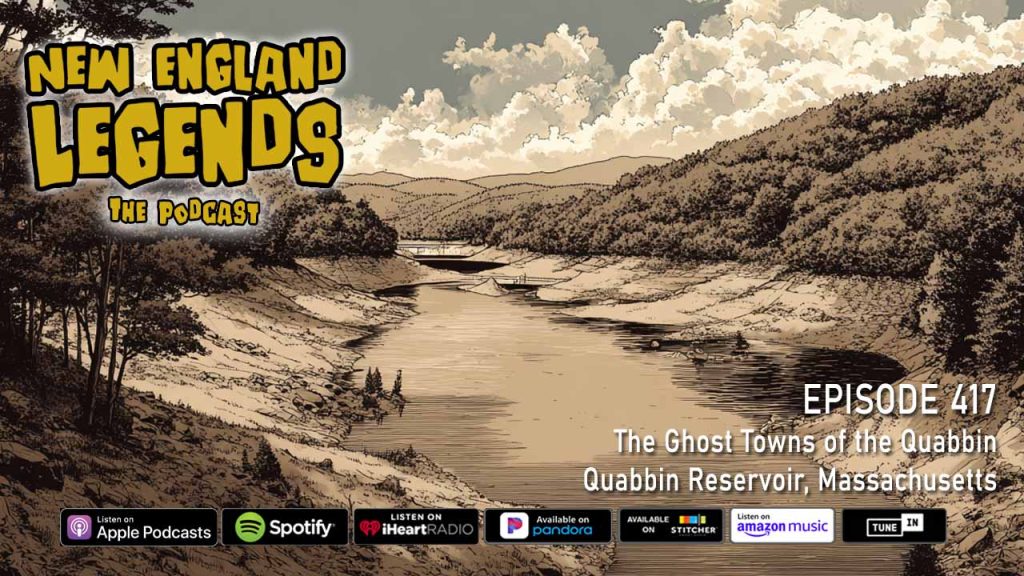
In Episode 417 Jeff Belanger and Ray Auger explore the ghost towns in and around the Quabbin Reservoir in central Massachusetts. In the 1930s, the towns of Dana, Enfield, Greenwich, and Prescott, Massachusetts with a combined population of about 2,500 people had to disincorporate in order for the Swift River Valley to flood and form the reservoir needed for Boston’s drinking water. What was left behind were scars, haunts, mysteries, and maybe a dirty secret many would rather not know about.
BECOME A LEGENDARY PATRON:
https://www.patreon.com/NewEnglandLegends
CREDITS:
Produced and hosted by: Jeff Belanger and Ray Auger
Edited by: Ray Auger
Theme Music by: John Judd
SUBSCRIBE TO THE PODCAST FOR FREE:
Apple Podcasts/iTunes | Spotify | Pandora | Amazon Podcasts | TuneIn | iHeartRadio
JOIN OUR SUPER-SECRET:
New England Legends Facebook Group
EPISODE TRANSCRIPT:
*A note on the text: Please forgive punctuation, spelling, and grammar mistakes. Like us, the transcripts ain’t perfect.
[CITY NOISES]
RAY: What brings us to downtown Boston today, Jeff?
JEFF: Ray, we’ve come for a glass of water.
RAY: A glass of water? I feel like we could have stayed home for that.
JEFF: We could but it wouldn’t make the same point. Let’s head into this bar and belly up.
[DOOR OPENS]
[LIGHT CROWD NOISE]
RAY:Two… uhhh waters please… Sparkling or tap?
JEFF: Tap. Definitely tap.
RAY: Tap I guess. Thanks!
JEFF/RAY: Cheers!
[CLINK]
RAY: Water isn’t what we usually order in a bar.
JEFF: No, it’s not. But I thought this would be a good place to start this week’s adventure. Do you know where this water came from?
RAY: You mean besides the tap behind the bar?
JEFF: Yeah.
RAY: I do know this one! It comes from the Quabbin Reservoir out in central Massachusetts.
JEFF: Correct! After we finish these, that’s where we’re headed next. We’re going to explore some ghost towns out there that may truly be haunted, and we’re going to give Bostonians something to think about the next time they take a sip of water…
[INTRO]
JEFF: I’m Jeff Belanger.
RAY: And I’m Ray Auger. Welcome to Episode 417 of the New England Legends podcast. Thank you, Legendarians, for joining us on our mission to chronicle every legend in New England one story at a time. We love ghosts, haunts, UFOs, monsters, roadside oddities, and all the other Wicked Strange things that make New England like no other place. Be sure to hit the subscribe button wherever you get your podcasts so you don’t miss a minute of the weirdness.
JEFF: We’ll head out to the Quabbin Reservoir right after this word from our sponsor.
SPONSOR
[RIDING IN CAR]
RAY: So it’s about a two hour drive out to the Quabbin Reservoir from Boston.
JEFF: Yeah, that sounds about right, depending on traffic. It’s roughly 60 miles as the ghost flies.
RAY: In the mid- to-late 1800s, Boston was growing at a fast rate. It was becoming a major international city, and to those who worked in the public works for the city, it was clear they were going to need more water.
JEFF: To you give you some perspective on the population growth, around the year 1680, Boston had a population of about 4,500 people. 40 years later in 1722 it had more than doubled to over 10,000. 100 years later in 1820 it quadrupled to over 40,000, by 1890, we’re talking a ten-fold increase to about 450,000 people. Ten years after that in 1900 about 560,000 people with no sign of slowing.
RAY: That’s a lot of people.
JEFF: Who need a lot of water.
RAY: Right. In the late 1800s, the Swift River Valley in central Massachusetts, was deemed the ideal spot for damming up the river to create a reservoir. There was just one problem.
JEFF: What’s that?
RAY: Well, FOUR problems technically.
JEFF: Okay… and they are?
RAY: There were four towns in that valley with about 2,500 people living there.
JEFF: So really… there were 2,500 problems.
RAY: I guess that’s true. Still, the massive region was sparsely populated, the water quality was good, and the natural topography made it ideal, because building one big dam could do the job of flooding the valley to create roughly 412 billion gallons of water for the metro Boston area.
JEFF: These are the kinds of decisions that are necessary if you’re going to grow as a region, but brutal to the people affected who are going to lose their homes.
RAY: The towns in the potential flood zone were Dana, Enfield, Greenwich, and Prescott. With the exception of Dana which was in Worcester County, the other three towns were in Hampshire County.
JEFF: When I was a kid, I remember my dad telling me that you can take a boat out on the Quabbin to go fishing and you could look down through the clear water and see church steeples and other buildings disintegrating in the waters below.
RAY: I remember hearing that as a kid too! How scary.
JEFF: Okay, you can pull over just about anywhere up here.
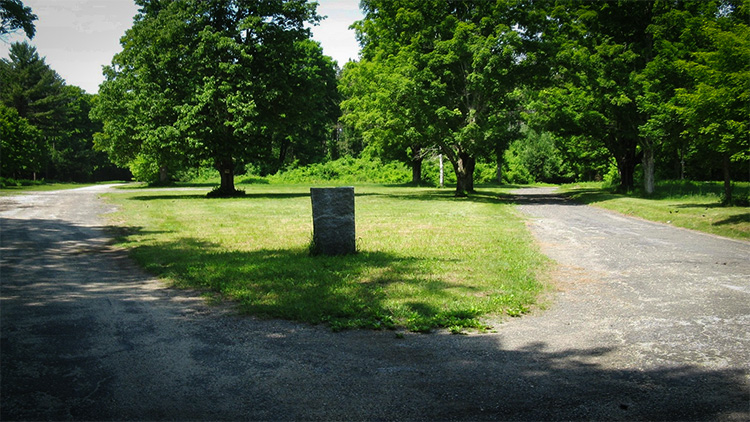
RAY: Got it. This looks like a town square. There’s a triangle formed by several intersecting roads. The only difference is there are no buildings.
[CAR STOPS DOORS OPEN AND CLOSE]
JEFF: This would be the former town common for the town of Dana.
RAY: I can see some historic markers in the grass around the common.
[WALKING IN WOODS]
JEFF: And over here there’s a cellar hole of a former building.
RAY: We’re about two football fields away from the edge of the waters of the Quabbin.
JEFF: That sounds about right.
RAY: I’m no engineer, but these roads are paved. There are some nice trees and land around this town common. And looking at this cellar hole, I’m not sure it had to be removed?
JEFF: You may be right. Or it could be that when they flooded the valley they couldn’t exactly predict how much would get submerged so they made their best guess and cleared out the towns.
RAY: Either way this is a ghost town now.
JEFF: A ghost town they say is actually haunted. To unlock the mysteries of the Quabbin, let’s head back to August of 1939.
[TRANSITION]
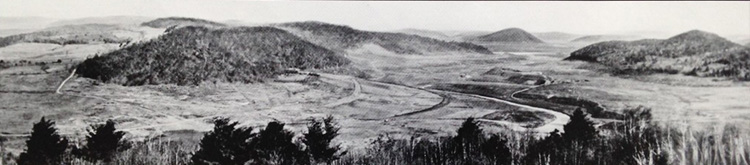
RAY: It’s early August of 1939, here in the former town common of Dana, Massachusetts. Franklin Roosevelt has been president of the United States for the past six years, and they’ve been some rough years for the county. The Great Depression has taken a toll on just about every community. Right now, we’re standing in front of what looks like a wasteland. It’s nothing but dirt for as far as I can see.
JEFF: Ironically this wasteland has created a ton of jobs over the past several years. Countless workers have been making way for a new reservoir to serve as a water supply for Boston. If you could swing an axe or a lift a shovel, you were hired. “Boston Woodpeckers,” is what the locals here called them. It’s been a decade filled with sweat, tears, and plenty of lawsuits.
RAY: The towns of Dana, Enfield, Greenwich, and Prescott, didn’t want to leave without a fight.
JEFF: That’s right. And then there was the state of Connecticut who sued because the reservoir means less water making its way down south to the Nutmeg State. A project like this is going to upset a lot of people.
RAY: No doubt. These were small towns full of farms, small businesses, and families who had been on these lands for generations. Though some may have been glad to get the pay day to leave, many would have rather remained in their homes and farms.
JEFF: There’s no easy way to do this project. Boston needs water, but the folks from this region will never forget what was done to them to accommodate a city some had never even visited. Some relented to the inevitable and even took jobs clearing out the trees and wood. They were allowed to keep the wood too, so a man could cut two chords in a day, earn what he was paid to clear and maybe another $12 dollars selling the wood. That was about a week’s pay in a single day.
RAY: It was in the 1890s that the need for more water was identified in Boston. They were watching the population growth and could clearly see a big problem on the horizon. By 1920, the Swift River Valley was identified as the best possible location for a reservoir. In 1926 a tunnel was constructed to connect the nearby Wachusett Reservoir to the Ware River which was needed to drain the valley and divert the river so they could construct a dam and clear out everything. Back in 1935, they began construction of the 2,640-foot Winsor Dam that would eventually hold back all of that water.
JEFF: As we can see they did indeed clear everything out. The trees, the houses, buildings, schools, churches, everything. It’s so desolate.
RAY: And depressing. I can see a few cellar foundations. I guess those will get flooded. But there are no buildings standing.
JEFF: Let’s take a walk over this way.
[WALKING]
RAY: Huh… this must have been a graveyard.
JEFF: Yeah. I’m sure you’re right.
RAY: I can see dozens of rectangles. I guess that’s where the headstones used to be.
JEFF: Riiiight.
RAY: Buuuut…
JEFF: Buuut?
RAY: It doesn’t look like any graves have been dug up. Just the headstones have been moved.
JEFF: That’s what it looks like to me too. There were about 7,500 graves from various cemeteries in the four towns that were supposed to be moved to Quabbin Park Cemetery over in the town of Ware.
RAY: There’s no way these graves were dug up.
JEFF: I agree.
RAY: And aren’t they flooding the valley in just a few days?
JEFF: That’s the plan, yes. On August 14th.
RAY: Oh man. I don’t think they’re moving the graves now.
JEFF: I don’t think so, no. The work here is done. Folks from the area towns have their last chance to walk their former land. The towns have all officially been disincorporated, and soon this are will all be under water. And that brings us back to today.
[TRANSITION]
JEFF: As you can imagine the displaced folks and even those who live nearby were pretty bitter for decades to come. When a government takes your land through eminent domain, it’s always upsetting. I get why it was done, but that doesn’t make it any easier for the people who lost their homes and farms.
RAY: No it doesn’t. So those rumors about people fishing on the Quabbin and seeing church steeples just aren’t true.
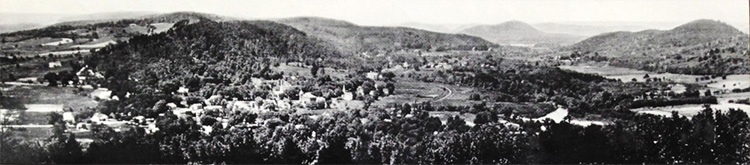
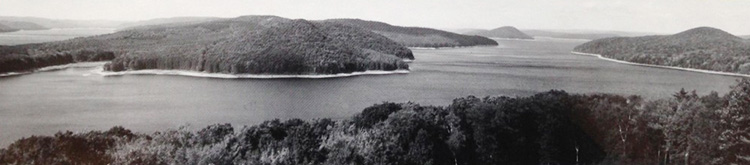
JEFF: No. You can see images of the land completely cleared on our website. Plus, not only are these ghost towns now, but people still claim to see echoes from the past.
RAY: Maybe it’s the displaced people, maybe it’s the displaced graves?
JEFF: Maybe. Plus there have been several plane crashes in and around the reservoir. In 1943 a B-24 Liberator bomber crashed in a swampy area killing two officers. In 1962 a F-102 Delta Dart fighter crashed in the woods killing the pilot, and in 1968 a Navy A-4 Skyhawk crashed in the woods killing the pilot. There were two other crashes here too, but those pilots safely ejected and survived.
RAY: That seems like a lot of plan crashes for one area.
Jeff: It does seem kind of high. Each event and incident only adds to the mystique and haunting of the Quabbin.
RAY: So it took seven years for the Quabbin to completely fill to capacity. The year was 1946 when the reservoir reached capacity, and that year Boston’s population was closing in on 800,000 people.
JEFF: That’s a lot of water.
RAY: Yeah it is.
JEFF: Way back around 2006, I was writing my book Weird Massachusetts, I got to interview a man named Bob Wilder. Wilder was in his eighties when I spoke with him. He was one of those 2,500 displaced people. Wilder grew up on his family farm on Prescott’s Ridge in Enfield. He heard all of the stories as a child, and made it his business to know all of the details of what happened as an adult. He’s the one who told me in the weeks before they began to flood the valley, people were allowed to walk their land one last time. He said he recalls seeing the rectangles where the headstones were pulled up from the ground, but said no graves had been dug up.
RAY: So that means there could be hundreds… if not thousands of bodies in the ground at the bottom of the Quabbin reservoir?
JEFF: That’s right.
RAY: Yikes… enjoy your drinking water, Boston….
[OUTTRO]
JEFF: Enjoy indeed… and that takes us to After the Legend where we take a deeper dive into this week’s story and sometimes veer off course.
RAY: After the Legend is brought to you by our patreon patrons! These people ARE legends. They help us financially with our hosting, production, travel, and all of the other costs it takes to bring you two podcasts each week. It’s just $3 bucks per month and for that you get early ad-free access to new episodes plus bonus episodes and content that no one else gets to hear. Come join our insiders at patreon.com/newenglandlegends
To see some pictures related to this week’s story, click on the link in our episode description, or go to our website and click on Episode 417
Hey Legendarians, did you know most of our story leads come from you? We love when you reach out to us through our website with your ideas. You never know when your story may be up next. Our website is also the place to see dates for Jeff’s story tour, dates to see my band the Pub Kings, a link to buy the Haunted New England calendar, and video clips as well. Please also consider posting a review for us or telling your friends about us, that’s how we grow.
We’d like to thank our sponsors, thank you to our patreon patrons, and our theme music is by John Judd.
Until next time remember… the bizarre is closer than you think.