
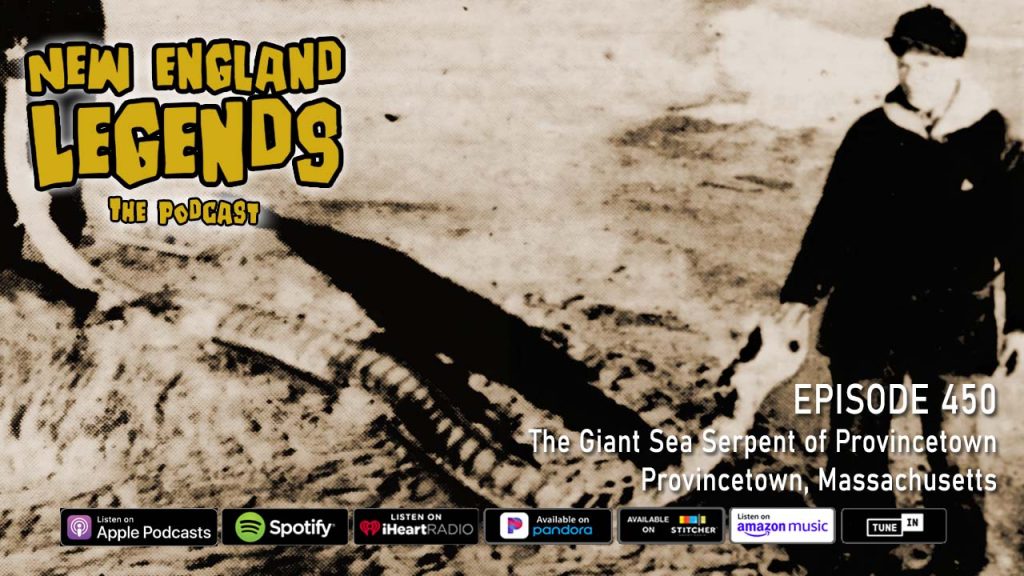
In Episode 450, Jeff Belanger and Ray Auger head to the tip of Cape Cod, Massachusetts, to search the waters off the coast of Provincetown to search for a giant serpent. In 1886 a rash of sightings made the newspapers, but in 1939 a mysterious skeleton washed up on shore. This time the camera was ready. What could this giant skeleton belong to?
BECOME A LEGENDARY PATRON:
https://www.patreon.com/NewEnglandLegends
CREDITS:
Produced and hosted by: Jeff Belanger and Ray Auger
Edited by: Ray Auger
Theme Music by: John Judd
SUBSCRIBE TO THE PODCAST FOR FREE:
Apple Podcasts/iTunes | Spotify | Pandora | Amazon Podcasts | TuneIn | iHeartRadio
JOIN OUR SUPER-SECRET:
New England Legends Facebook Group
EPISODE TRANSCRIPT:
*A note on the text: Please forgive punctuation, spelling, and grammar mistakes. Like us, the transcripts ain’t perfect.
[OCEAN SHORE SOUNDS]
RAY: It’s practically summer, Jeff! What a great time to visit the beach.
JEFF: Definitely. And here at the very tip of Cape Cod, in Provincetown, we have an incredible view of the ocean.
RAY: There’s a reason they call this place: land’s end. To our southwest is Boston Harbor, to our north and east is the wide open ocean.
JEFF: Keep your eyes on the sea, Ray. Because we’re looking for a monster.
RAY: Great White sharks are reported out this way every summer. Has there been a sighting recently?
JEFF: Not yet. But we’re not here looking for a shark. We’ve come to Provincetown, Massachusetts, to search for… a giant sea serpent.
[INTRO]
JEFF: I’m Jeff Belanger. Welcome to Episode 450 of the New England Legends podcast.
RAY: And I’m Ray Auger. Thanks for joining us in our mission to chronicle every wicked strange legend in New England one story at a time. We’re always on the hunt for monsters, ghosts, aliens, roadside oddities, weird history, and everything else that makes the northeast like no other place. We can’t do it without you! Please email us anytime through our website with your story leads. We love hearing from you.
JEFF: We’ll go hunting for the Giant Sea Serpent of Provincetown right after this word from our sponsor.
SPONSOR
RAY: Jeff, this is NOT the first sea serpent we’ve searched for.
JEFF: Not even close.
RAY: We’ve covered Cassie the Sea Serpent from Casco Bay in Maine way back in Episode 16.
JEFF: Right.
RAY: We’ve covered the Plymouth Sea Serpent back in Episode 392. That one was spotted by none other than Daniel Webster himself.
JEFF: There’s that.
RAY: We’ve also mentioned the Gloucester Sea Serpent, and we’ve covered the Block Ness Monsters from Block Island, and we’ve mentioned the sea serpent spotted off the coast of the Lordship Lighthouse in Stratford, Connecticut.
JEFF: True. And that’s just the salt water kind.
RAY: If we include fresh water, then we can throw in Champ of Lake Champlain, the Connecticut River Monster, Memphre of Lake Mephremagog, and the monster of Lake Willoughby in Vermont. And I bet I’m even forgetting a few.
JEFF: These serpents come up a lot in New England.
RAY: They do.
JEFF: Many of those stories were mostly hearsay stories from witnesses throughout the centuries. But this one is a little different.
RAY: How so?
JEFF: Because we have a photo of the skeleton of this giant beast. It washed up on shore. That skeleton belonged to something. To find out what, let’s head back to the year 1939.
[TRANSITION]
[OCEAN SOUNDS]
RAY: It’s January of 1939 here in Provincetown, Massachusetts. America is clawing its way out of the Great Depression. Just a few days ago President Franklin Roosevelt gave his State of the Union Address where he warned of a coming storm against Democracy, and the rise of global aggression from fascist dictators. But here in Provincetown, that still feels like worlds away. Fishing is the industry that most locals are focusing on right now.
JEFF: That makes sense. That’s the job at hand. Fill those fishing nets, sell your catch, and do it all again tomorrow. Being January, the job is a lot tougher because of the biting wind and frigid temperatures. The waters out here can be rough.
RAY: Down at the fishing docks, some of the old timers have heard recent stories of a giant serpent seen in the waters off the shore. Some of them are old enough to recall the sightings in these parts that date back to 1886.
JEFF: Back then there was a giant serpent spotted near the beach and even on land! Ray, go ahead and read this eyewitness account from an 1886 newspaper article on the sighting. It was reported by the town crier, George Washington Ready.
[SHUFFLES PAPER]
RAY: Okay, according to the article, Ready said quote, “I was walking along the beach at Herring Cove when I saw a monster 300 feet long, colored like a rainbow, and with sharp, bony scales like the teeth of a mowing machine. It scorched a path over the dune, cutting down with its huge tail trees a foot in diameter, and then disappeared in Pasture Pond. As it slid in, the water gradually receded until the pond was drained completely. Only a great hole remained in the center of the pond bed. I ran to town to get a 250-fathom sounding line, but I couldn’t reach the bottom of the hole. That was the last seen of the serpent.” The article concludes with Ready referencing his first two names, George Washington, and that he cannot tell a lie, nor was under the influence of liquor or anything else.
JEFF: Pasture Pond is a little less than a mile inland from the shore of Herring Cove.
RAY: That’s a long way over land for a sea serpent to travel.
JEFF: A sea serpent that’s almost the length of a football field.
RAY: Well, believe that 1886 story or not, according to some of the fishermen, the giant serpent is back, though no descriptions match the one from over 50 years ago. These guys claim they’ve seen a giant snake in the water.
[OCEAN WAVES BREAKING ON SHORE IN DISTANCE]
JEFF: It’s Monday, January 16th, and we’re standing near the Wood End Coast Guard Station and lighthouse. There’s been some commotion on the beach.
RAY: It’s a sunny day. It’s cold, but at least the visibility is good. We should head down to the beach and see what the fuss is about.
[OCEAN WAVES LOUDER]
RAY: Woah… would you look at that!
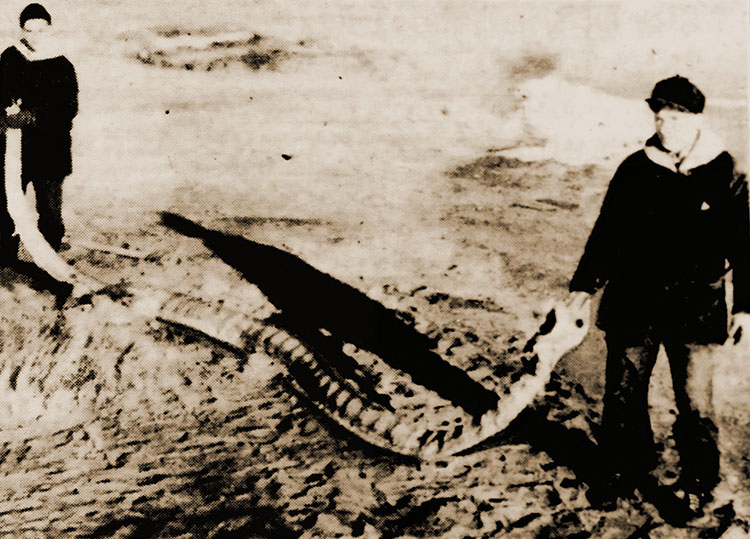
JEFF: It’s a giant skeleton with just a little bit of skin still on it. It’s clearly been dead for a long time. It’s about 30 feet in length!
RAY: One of the Coast Guardsmen are counting the vertebrae. How many? He said it looks like there are 71 sections for vertebrae here.
JEFF: There’s more to see. Look at the end.
RAY: Oh yeah! Clearly the rest of it broke off. Who knows how much longer this thing would have been.
JEFF: The commander of the Coast Guard station, Boatswain Addison Ormsby told me he’s never seen anything like it. He doesn’t think it was a whale or a blackfish. He said the head looks something like a crocodile, except there’s no teeth in the skull and the center of the skull has a hole in it.
RAY: Look back here about halfway down the trunk.
JEFF: It looks almost like this is where there would have been legs? Or maybe flippers of some kind?
RAY: Here comes the photographer from the newspaper. Go ahead and hold the ends up, boys!
[PHOTO BULB FLASH]
RAY: Great shot.
[OCEAN FADES OUT]
JEFF: As the picture of the skeleton begins to circulate in the newspapers, there are various theories as to what it could be, but none of them quite fit. There are very few animals over 30 feet long in the ocean. There’s squid and the Giant octopus—the squid can grow up to 39 feet.
RAY: But neither of those animals have skeletons.
JEFF: Right. There’s the oarfish. That can grow up to 26 feet in length.
RAY: But this could have been at least 10 feet longer than that if you figure the tail and maybe more is missing from the skeleton. Plus, that doesn’t explain the hole in the head and the oarfish is kind of like a giant eel. There’s no fins or legs past the head.
JEFF: Some of the old timers shrug and tell you, that’s clearly the remains of a giant sea serpent. There can be no doubt for them. And that brings us back to today.
[TRANSITION]
RAY: I love that we have a photo of this thing. There it is in black and white for all to see. It doesn’t seem to quite fit the description of anything else other than a giant serpent.
JEFF: And suddenly we start giving a lot more credence to all of the other various sightings of sea serpents that have come out of New England over the past several centuries.
RAY: Okay, when I compare this picture to the one we have of the Block Nes Monster that was taken in 1996, they look a lot alike. I’m no zoologist, but you can’t argue that these could be the same creature.
JEFF: I agree. And not to ruin Episode 90 of our podcast on the Block Ness Monster, but those bones eventually went missing and have never turned up again.
RAY: There’s a lot we don’t know about the ocean. I looked up the longest sea creatures, and as we mentioned, the oarfish comes in around 26 feet in length, a Great Whie Shark can get to be about 23 feet, a whale shark about 62 feet, sperm whale can get to almost 79 feet, and a Blue Whale at 108 feet in length.
JEFF: We also need to realize that the distance from Block Island to the tip of Cape Cod is only about 120 miles. It’s another 50 miles up to Gloucester, Mass, and maybe 110 miles up to Casco Bay in Maine. For an animal that’s 40 feet or more in length, that’s just not very far to travel. So maybe these waters have been overfished over the past century, and this giant serpent had to move on to where there’s more food for an animal that size.
[OCEAN NOISES FADE IN]
RAY: If this serpent can survive on land, like that report from 1886 suggests, I can’t imagine something that big slithering through our lakes and ponds knocking over trees and digging holes hundreds of feet deep.
JEFF: I get that. I don’t care to share the land with something that big and scary. A true monster. Still, as we look out over the water here at the tip of Cape Cod, I can’t help but wonder if the sea serpent is still out there somewhere and ready for its 21st century comeback.
[OUTTRO]
RAY: And that takes us to After the Legend where we take a deeper dive into this week’s story and sometimes we veer off course.
JEFF: After the Legend is of course sponsored by our Partreon patrons. Oh man we love our patrons. They’re our lifeblood. They keep us going and growing. They help us with all of our hosting costs—costs that have gone up for us recently, our production, travel, marketing, and everything else it takes to bring you two stories each week. We’re an independent production. There’s nobody behind us but you. So we appreciate it. It’s just $3 bucks per month for early ad-free access to new episodes plus bonus episodes and content that no one else gets to hear. Please head over to patreon.com/newenglandlegends to sign up.
To see a picture of the 1939 Provincetown Sea Serpent, click on the link in our episode description, or go to our website and click on episode 450.
Hey! There’s another way you can help us grow. Maybe you’re not ready to become a patreon patron, how about posting a review for us, or sharing our episodes with your friends? That goes a long way in helping others find us and then they share their local weird stories and we keep on rolling. It takes a community to do this, we appreciate being part of it with you. Also check out our website for links to all things Jeff and Ray. There’s a calendar to see dates for Jeff’s story tour, dates to see my band the Pub Kings, an interactive map to every location we’ve covered so far, and so much more.
We’d like to thank our patreon patrons, thank you to our sponsors, and our theme music is by John Judd.
Until next time remember… the bizarre is closer than you think.