In Episode 454, Jeff Belanger and Ray Auger hunt the woods of St. Albans, Vermont, searching for the site where Lawrence Brainerd shot and killed a legendary wolf that was terrorizing the region back in 1839. Today a monument stands in a remote section of the woods where the mighty beast fell.
BECOME A LEGENDARY PATRON:
https://www.patreon.com/NewEnglandLegends
CREDITS:
Produced and hosted by: Jeff Belanger and Ray Auger
Edited by: Ray Auger
Theme Music by: John Judd
SUBSCRIBE TO THE PODCAST FOR FREE:
Apple Podcasts/iTunes | Spotify | Pandora | Amazon Podcasts | TuneIn | iHeartRadio
JOIN OUR SUPER-SECRET:
New England Legends Facebook Group
EPISODE TRANSCRIPT:
*A note on the text: Please forgive punctuation, spelling, and grammar mistakes. Like us, the transcripts ain’t perfect.
[WALKING THROUGH WOODS]
RAY: We are wayyyy up here in northern, Vermont, Jeff. St. Albans is less than 14 miles from the Canadian border.
JEFF: We’re also pretty close to Lake Champlain. It’s just a couple of miles to our west. It’s wild country up here for sure.
RAY: So we’re climbing up Aldi’s Hill in the Hard’ack Recreation Area. It’s a pretty day for a hike. The trail is easy to follow.
JEFF: Aldi’s hill is 850 feet tall. So not the tallest hill in Vermont by a long shot. But there’s a strange monument at the top. That’s what we’re searching for.
RAY: This is a remote place for a monument. I can’t imagine too many people see it up here. What’s the monument for?
JEFF: The monument marks the place where they say back in 1839, a man named Lawrence Brainerd shot and killed… a monster.
[INTRO]
JEFF: I’m Jeff Belanger. Welcome to Episode 454 of the New England Legends podcast.
RAY: And I’m Ray Auger. Thanks for joining us on our mission to chronicle every wicked strange legend in New England one story at a time. We’re always on the hunt for monsters, ghosts, aliens, roadside oddities, and all of the other weirdness that makes our region unique.
JEFF: We get messages and comments at times that say: why don’t you do more stories from Rhode Island, or Vermont, or whatever state they’re from. Did you know that each week we move through each of the six New England states? So if today is a Vermont story, we’ll be back here in six more weeks.
RAY: Right. Annnnd most of our story leads come from you. So please reach out to us anytime through our website with your story ideas. We love hearing from you.
JEFF: We’ll go looking for this northern Vermont monsters right after this word from our sponsor.
SPONSOR
[WALKING THROUGH WOODS]
RAY: We’ve been to St. Albans before.
JEFF: We have.
RAY: I remember we found a story of a fur bearing trout from St. Albans.
JEFF: That’s right!
RAY: What is it with weird animals way up here in northern Vermont?
JEFF: I’m not sure, but a fur-bearing trout isn’t a danger to anyone. The monster we’re looking for… is.
RAY: Oh my.
JEFF: Ray, have you heard of the Dire Wolf?
RAY: Oh, I’ve seen Game of Thrones. I’m familiar.
JEFF: The dire wolf could weigh 150 pounds and stood a little larger than most other wolves that we know about today. They lived in the Americans during the late Pleistocene period from about 125,000 years ago to as recently as 10,000 years ago. So there were humans like us that would have seen some around before the dire wolf went extinct.
RAY: Woah woah woah, there Jeff.
JEFF: What?
RAY: On October 1st, 2024, Colossal Biosciences announced the return of the Dire Wolf.
JEFF: What do you mean?
RAY: Using genetic engineering, they de-extincted the dire wolf. They announced the birth of three pups named Romulus, Remus, and Kesi. There’s even a photo of Game of Thrones author, George R.R. Martin holding one of the new dire wolves.
JEFF: So we brought a predator back from extinction. What could possibly go wrong?
RAY: Have you seen the Jurassic Park movies?
JEFF: I did! But I don’t remember any moral to the story.
RAY: Right. So nothing could go wrong bringing back the dire wolf. To be fair, critics will tell you what Colossal Bioscience did was heavily edit the DNA of a gray wolf to create something genetically close to dire wolf. But still. These new wolves are big.
JEFF: If they only went extinct 10,000 years ago, it does beg the question if maybe a few of them survived much later than that. Maybe… just maybe there was one right here on Aldi’s Hill in St. Albans. To find this beast, let’s head back to the year 1839.
[TRANSITION]
RAY: It’s July of 1839. Martin Van Buren is in the White House, Silas Jennison is governor of Vermont, and here in St. Albans, and really all of northeastern Franklin County, folks are nervous.
JEFF: That they are. Not because of anything happening in local or national politics, but because a predator has been terrorizing local farms and homes in the region.
[NIGHT CRICKETS FADE IN]
JEFF: It’s pretty late. We’re standing outside of the Brainerd homestead here in St. Albans.
[LOW WOLF GROWL]
JEFF: Did you hear that?
RAY: Yeah I did. Look over there…
[LOWD GROWL CHICKENS FREAK OUT]
RAY: It’s a wolf. It’s huge and attacking their chickens!
[HEY! VOICE FROM A DISTANCE]
[SHOTGUN BLAST]
[CHICKEN FREAK OUT FADES]
RAY: That gunshot scared off the wolf.
[WOLF AHHHOOOOOOO IN THE DISTANCE]
JEFF: The following day, Lawrence Brainerd is sharing news of the attack with some of his neighbors. That’s when he learns he’s not the first to experience a wolf attack in recent days. Others have lost animals too. Sheep, chickens, really no farm animal is safe from a predator this size.
RAY: At Sunday’s church service, the monster wolf is all anyone can talk about after the service ends. People are scared for their livestock. Mothers are scared for their young children.
JEFF: Brainerd knows something has to be done.
RAY: We should probably tell you a little more about Lawrence Brainerd. Though he was born in East Hartford, Connecticut, when he was nine years old, Brainerd moved to live with his uncle in Troy, New York. When he turned 14, they moved to St. Albans, Vermont, and that’s been home ever since. Brainerd served as a sergeant during the War of 1812, and got into politics in 1834 when he was elected to the Vermont state House of Representatives.
JEFF: Brainerd is a member of the whig party. He’s been a huge advocated for abolition. He’s in good company in Vermont. This was the first territory to ban slavery. They did that in 1777 on the day they adopted their state constitution.
RAY: So this is a man in the public eye who has run for office before and always has his sites set on bigger political aspirations.
JEFF: Right… so solving this wolf problem for his community wouldn’t hurt his chances with voters.
RAY: No it wouldn’t.
[LOADING MUSKET]
RAY: Lawrence Brainerd loads his musket. Packs his hunting bag.
[DOOR OPENS / DOOR CLOSES]
RAY: And sets off looking for this massive wolf that’s been stalking the St. Albans community.
[WALKING THROUGH WOODS]
JEFF: Brainerd visits some of the homes and farms near his own. He learns one neighbor lost a few chickens the night before. The bloody mess is still fresh on the ground.
RAY: The area got some rain late yesterday afternoon, so there’s still some mud and soft ground right now. It doesn’t take long for Brainerd to find the trail.
JEFF: Wow! Look at the size of those prints!
RAY: Yeah.
JEFF: I’m no expert tracker, but clearly this animal is large and heavy enough to sink down into the muddy spots.
RAY: Those prints look way bigger than a large dog’s.
JEFF: And look at how spread out they are.
RAY: This is one big wolf we’re hunting.
[LURKING THROUGH WOODS]
RAY: For hours, Brainerd tracks the beast. He walks miles through the woods, through fields, and eventually makes his way to Aldi’s Hill.
JEFF: Wait look! Up ahead!
RAY: I see it! I saw a flash of gray. It’s heading further up the hill among the trees!
[RUNNING THROUGH THE WOODS]
RAY: Brainerd is closing fast.
JEFF: He’s only going to get one crack at this if that giant beast stops for a rest.
[RUNNING STOPS]
JEFF: (WHISPERS) That’s the largest wolf I’ve ever seen.
RAY: (WHISPERS) It’s huge! I didn’t know they could get that big.
JEFF: (WHISPERS) Okay, Brainerd is raising his musket…
[MUSKET FIRE]
[CANINE YIPS]
RAY: I think he got him!
JEFF: Let’s go check it out!
[RUNNING IN WOODS]
JEFF: This giant wolf is dead. Right here near the top of Aldi’s hill.
RAY: Word spreads fast around St. Albans that Lawrence Brainerd has killed the giant wolf that had been terrorizing the community. The nightmare, it would seem, is over.
JEFF: A few locals come to check out the carcass of the dead wolf. He’s roughly twice the size of any gray wolf anyone has ever seen around here before. Brainerd’s prowess as an outdoorsman and hunter is sealed for life around St. Albans.
JEFF: Years pass and people start to forget the wolf. And Lawrence Brainerd has not forgotten about politics. It’s now 1853, and Brainerd is eying a run as a United States Senator from Vermont.
[CHISELING ON STONE]
RAY: That’s when a local women’s group raises some funds to erect a monument to Brainerd for his bravery in slaying the giant wolf.
[CHISELING STOPS]
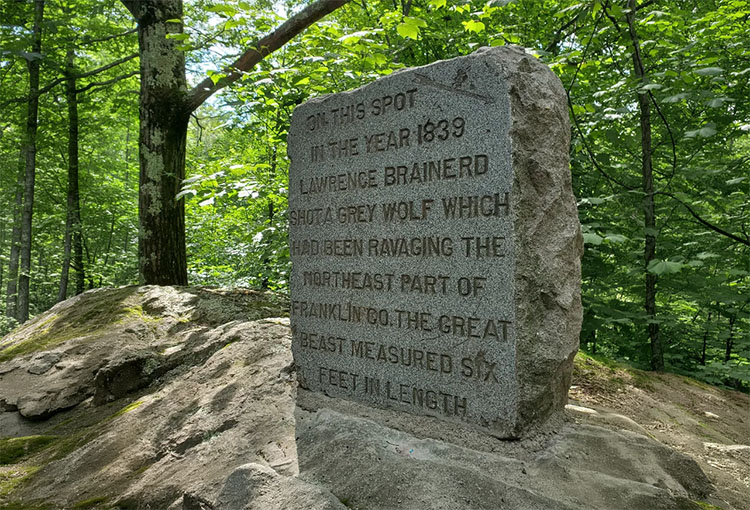
RAY: The monument is placed near the top of Aldi’s Hill in St. Albans. It reads: “On this spot in the year 1839, Lawrence Brainerd shot a grey wolf which had been ravaging the northeast part of Franklin County. The great beast measured six feet in length.
JEFF: With the monument firmly in place, everyone who walks by gets a reminder of the brave and powerful hunter who slayed the monster for their community. It’s October of 1854 when Lawrence Brainerd takes office as a U.S. Senator from Vermont. And that takes us back to today.
[TRANSITION]
JEFF: The monument has been knocked over a few times over the years. I found a newspaper article from 1916 suggesting it had been knocked over by some boys messing around with it, so it was cemented to a stone, which is how it sits today. This article also mentions that some women had erected the monument long ago.
RAY: There’s another theory that former Vermont governor John Gregory Smith who served as governor from 1863 to 1865 had erected the stone as an odd tourist attraction honoring his father-in-law, Lawrence Brainerd.
JEFF: Right, the governor married Brainerd’s daughter. To be fair we don’t know exactly who placed the monument or when. We’re speculating that the marker went up during Brainerd’s political run as a kind of public relations shot in the arm. But a family favor from his son-in-law is also possible. Either way, the marker is here now as an obscure and remote monument to a giant beast.
RAY: Do you think it could have been an actual Dire Wolf that someone survived extinction?
JEFF: Here’s the thing… the Dire Wolf wasn’t officially discovered until 1854. Some fossilized bones were found on the banks of the Ohio River. The paleontologist who discovered the bones named the giant beast Canis Dirus, or the dire wolf. But it does beg the question: If these things were alive 10,000 years ago, is it possible for a few of them to have slipped through? The extinction event was thought to be caused by too many large animals like wooly mammoths and dire wolves fighting over dwindling food resources. So maybe a few small numbers slipped away to parts of the country where they didn’t have to compete?
RAY: Or maybe this was just an unusually large grey wolf.
JEFF: Right. It could be that, too. And a six foot long grey wolf isn’t unheard of.
RAY: This could also be kind of like a fishing story, right?
JEFF: Maybe.
RAY: Each time you tell the story the fish gets a little bigger, and a little bigger, until it’s Moby Dick.
JEFF: Right. I’m sure there’s a little of that happening here with the great wolf of St. Albans. Either way, we do have a story chiseled in stone out here in the woods, that tips its hat to a local man who slayed a giant monster.
[OUTTRO]
RAY: And that takes us to After the Legend where we take a deeper dive into this week’s story and sometimes veer off course.
JEFF: After the Legend is brought to you by our patreon patrons! Thank you, patrons, for helping us financially with all of the costs it takes to bring you two stories each week. We appreciate you for your help in keeping our lights on. We don’t have a big podcast network behind us, we work for you. It’s just $3 bucks per month and for that you get early ad-free access to new episodes, bonus episodes no one else gets to hear, and access to our entire archive of shows. To help the cause, please click over to patreon.com/newenglandlegends to sign up.
To see some pictures of the St. Albans monument, click on the link in our episode description, or head to our website and click on Episode 454.
We need you to subscribe to our podcast wherever you get your podcasts because it’s free. We make a great companion on your commute, or on your road trips, listen to us at home, at the gym, or anywhere you need a little weirdness in your life. It also helps us quite a bit when you post a review for us and share our episodes with your friends. Spreading the word goes a long way.
We’d like to thank our sponsors, thank you to our patreon patrons, and our theme music is by John Judd.
Until next time remember… the bizarre is closer than you think.