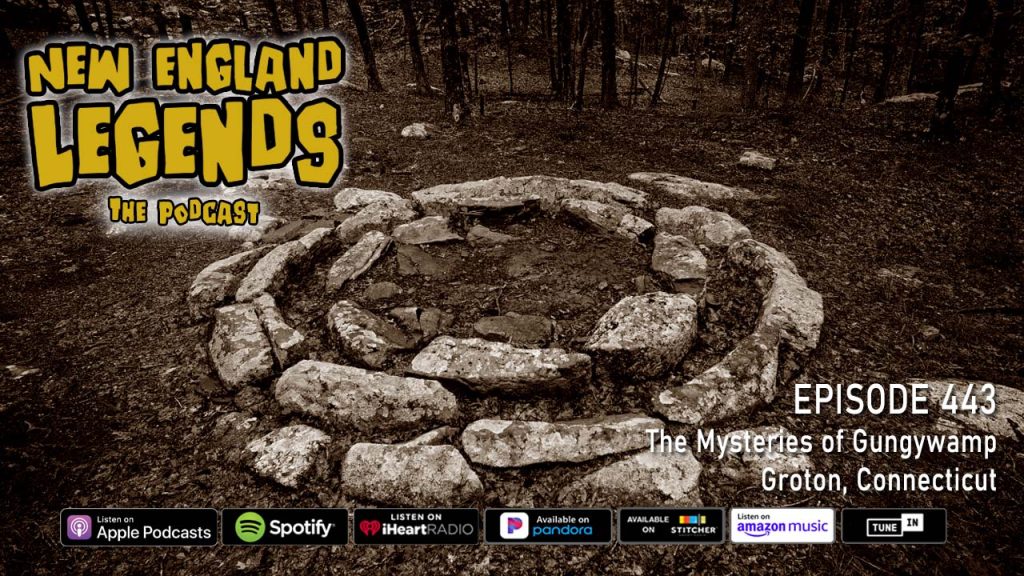
In Episode 443, Jeff Belanger and Ray Auger explore the stone ruins of Gungywamp in the woods of Groton, Connecticut. This mysterious site could date back as much as 3,000 years and includes strange stone structures from the Native American period as well as the Colonial. Could there also be some European influence here from long before Columbus or the Vikings?
BECOME A LEGENDARY PATRON:
https://www.patreon.com/NewEnglandLegends
CREDITS:
Produced and hosted by: Jeff Belanger and Ray Auger
Edited by: Ray Auger
Theme Music by: John Judd
SUBSCRIBE TO THE PODCAST FOR FREE:
Apple Podcasts/iTunes | Spotify | Pandora | Amazon Podcasts | TuneIn | iHeartRadio
JOIN OUR SUPER-SECRET:
New England Legends Facebook Group
EPISODE TRANSCRIPT:
*A note on the text: Please forgive punctuation, spelling, and grammar mistakes. Like us, the transcripts ain’t perfect.
[WALKING IN WOODS]
RAY: We’re hiking along a trail in Groton, Connecticut.
JEFF: We are.
RAY: There’s plenty of forest, there’s a swampy pond to our left, and now we’re heading up a hill. I have to say, once we started climbing the hill, the forest feels different.
JEFF: I felt that too. On the one hand, we’re moving to slightly higher ground above the swamp. The trees are taller and the forest is more dense up here.
RAY: Still… I’ve got the creeps.
JEFF: I get that. Maybe that’s because our destination is just ahead, Ray.
RAY: Okay, I see several old Colonial stone walls… and on our right. That looks like an old Colonial House foundation.
JEFF: Yup, that it is, and just ahead are many more stone structures. While the walls and that foundation date back to the Colonial period, there’s more structures in this stone village that date back thousands of years. Grab your Indiana Jones hat, Ray. We’ve come to Groton, Connecticut to explore the mysteries of Gungywamp.
[INTRO]
JEFF: Hello, I’m jeff Belanger.
RAY: And I’m Ray Auger. Welcome to Episode 443 of the New England Legends podcast. We’re on a mission to chronicle every legend in New England one story at a time, and we can’t do it without you. If you’ve got a tale of ghosts, monsters, aliens, ancient mysteries, roadside oddities, or other weirdness you think we should check out, reach out to us anytime through our website.
JEFF: We’ll explore the mysteries of Gungywamp, right after this word from our sponsor.
SPONSOR
RAY: Gungy… who?
JEFF: Gungywamp. It’s both an archeologist’s dream and nightmare.
RAY: I can see why it’s a dream. There are a lot of structures in this one area. Stone walls, stone chambers, the old foundation we passed before, and up ahead is a strange circle of stones.
JEFF: Plus, there are some stones with some carved petroglyphs nearby too. You’ve got structures from many different eras here. What’s most curious to me is that as new people came along, they didn’t destroy what was here before.
RAY: Huh, yeah, I guess that is a little weird.
JEFF: I don’t mean destruction for the sake of destruction, I mean if you build a house and intend to make land your own, you might rework everything to suit your needs. Maybe it’s a small farm and you want a bordered area for some livestock, or fields to grow food. Whoever lived here, never messed with what was here before as far as we can tell.
RAY: Here’s a little more background on Groton, Connecticut. The town sits near the mouth of the Thames River on Long Island Sound. Yes, I pronounced Thames the way the locals do, even though it makes our British friends cringe because it’s spelled the same as the famous river in London, England.
JEFF: Right. The British version would be the Thames.
RAY: Right. Here it’s the Thames. Way back in the year 1614, Dutch explorer Adrian Block, first mapped the coast. He noted this area was a stronghold for the Pequot people. Europeans attacked the Pequot fort here in 1637 and drove them out. Settlers began to move in around 1646. Given the location at the mouth of a river that spills into Long Island sound, the region became known for farming and then ship building.
JEFF: That makes sense. Over time villages turned into towns, towns into cities. People came and went, yet this spot on the hill called Gungywamp still offers us a mysterious look into the past. It’s kind of time capsule.
RAY: With all of these tall trees, I can’t imagine this area was good for farming.
JEFF: You need to remember that these trees aren’t that old. A century ago this would have been rolling hills. Sure the land was still full of rocks, but the trees weren’t here yet. Gungywamp is a place of mystery. Some claim there’s pre-Columbian—even pre-Viking—evidence of Europeans here. Others say it’s just a strange collection of rocks.
RAY: I’m no archeologist, but even I can see that we don’t see stone structures like this every day. I see small stone chambers, a large circle of stones in a circle. This isn’t the kind of site we see very often.
JEFF: No we don’t. To find out how they got here, let’s head back to the year 1983.
[TRANSITION]
RAY: It’s September of 1983 here in Groton, Connecticut. Ronald Reagan is president of the United States, William O’Neil is the governor of Connecticut, and “Sweat Dreams are Made of These” by the Eurythmics is number one of the radio. Up here at the Gungywamp site, things are bustling.
[DIGGING / HAMMERING ON ROCKS]
JEFF: That they are! The whole site is being studied by a group who calls themselves the Gungywamp Society.
RAY: That’s a good name.
JEFF: It is. The group of amateur archeologists formed in 1978 to study this site. To measure, catalog, and photograph everything they can find. The group was founded by David Barron to study this 100 acre site.
RAY: 100 acres!?
JEFF: I know, right? To be fair, most of the interesting stuff is right where we’re standing and could fit in maybe two acres.
RAY: I guess if we included the swamps and trails…
JEFF: Right. It gets significantly bigger. Let’s check out one of the stone chamber first.
[WALKING IN WOODS]
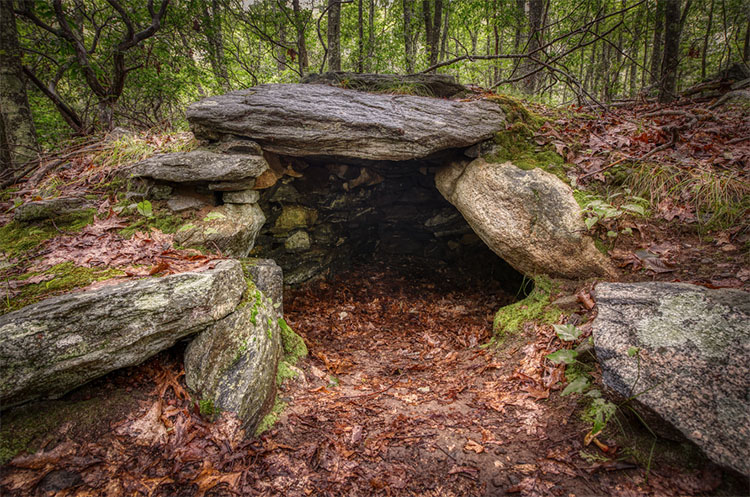
RAY: Okay, this chamber is maybe the size of a small backyard shed. It’s built into a small hill. We had to duck to walk through the entryway.
JEFF: Right.
RAY: And there’s an opening near the top of the back of the chamber. Maybe that allows light to get in?
JEFF: Yes, it does allow light.
RAY: You couldn’t live in here. It’s too small. I guess it could be a place for storage? Like a root cellar?
JEFF: It could be, but one problem is that it’s wide open to animals. If you’re storing anything in here like potatoes, you’d need to keep them enclosed in something. Here’s the other strange thing about this chamber. That opening at the top?
RAY: Yeah?
JEFF: During the Spring and Fall Equinox, the sun would shine directly through that opening and illuminate a specific stone in the lower corner near the entrance.
RAY: Wow, that’s some Indian Jones stuff right there. If we push that rock on the Equinox does some giant bolder chase us out of here for stealing a golden statue?
JEFF: Not that anyone has ever reported. Still, this chamber doesn’t quite fit the mold for early Colonial settlers, nor does it fit the mold for Native American structures. Which has allowed some archeologists to let their minds drift over to Europe. They question if some of these chambers could be Celtic in origin and date back as early as the fifth century. Or could this be some kind of alignment chamber? A kind of storage shed calendar, or maybe even a sacred site?
RAY: Huh. The Celts would have had a long and dangerous sea voyage to get over here that long ago.
JEFF: They would. One thought would be if they headed west in a ship, they could have made stops at Iceland, Greenland, then northern Canada. Follow the coast south and you could eventually find this spot right here. Kind of like the Vikings. So not impossible, still, most mainstream archeologists doubt Europeans were here before the Vikings who were definitely here before Christopher Columbus.
RAY: One artifact unearthed here by the Gungywamp Society a few years back is a Susquehanna broadpoint. It’s a kind of wide arrowhead that could be used to tip a spear or even used as a knife. They’ve been found from Pennsylvania through New York, and even into New England. This arrowhead dates back to around 1000 B.C. It could have been acquired in a trade with the Pequot people who once called this region home.
JEFF: That’s a long period of human activity here. We’re talking 3000 years right where we’re standing.
[WALKING IN WOODS]
JEFF: Let’s head to the top of the hill.
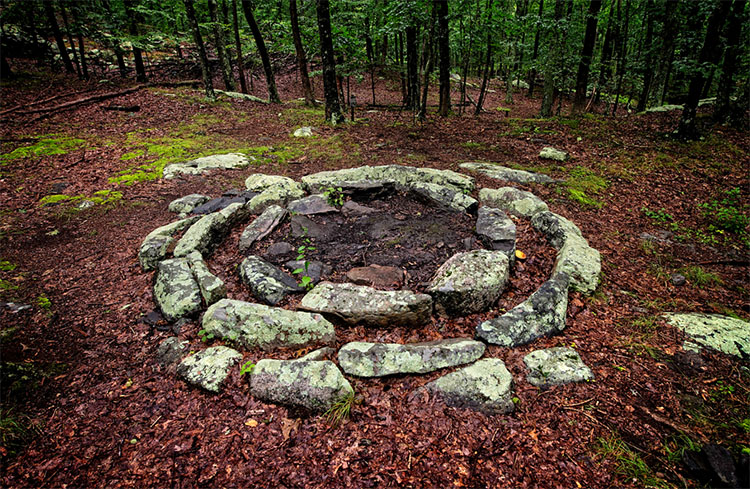
RAY: Okay, I haven’t seen anything like this before. We’re looking at several rings of stones in the ground. The outer circle is maybe 10 feet in diameter. The rocks are about the size of the rocks you find in nearby stone walls. They’re all standing on their sides forming the two circles.
JEFF: Some people believe this stone circle is some sort of ceremonial site. Its function lost to time. Others claim that it could be colonial in origin, that it’s similar to bark mills found elsewhere. You would lay tree bark on the stones, place a second stone on top and have an animal help turn the wheel to extract tannins for tanning leather.
RAY: I’m starting to see a pattern here. It could be an ancient mystery, but it could also be just an old functional tool.
JEFF: Right. Let’s keep moving.
[WALKING IN WOODS]
RAY: Okay, we’re walking down next to a ledge. It’s not that tall, but you’d definitely prefer not to fall off of it. As we’re coming around the side, I can see a bunch of larger stones standing on their sides. They’re almost the same size and shape as some low-to-the-ground headstones. But clearly they’ve been placed here by people.
JEFF: It’s a row of 29 stones about two and a half feet apart from each other. Take a look at this one.
RAY: I can kind of see the faint carving of a bird on this stone.
JEFF: We’re guessing some of the other stones had carvings on them as well, but they’ve been weathered away over the centuries. The row of stones runs north with a slight arc to it.
RAY: Just to be clear, these standing stones aren’t exactly a feat of human engineering.
JEFF: No.
RAY: I mean, the two of us together could probably erect one of these stones if we had to.
JEFF: I’m sure we could.
RAY: When we first walked up the trail to Gungywamp, we could clearly see the stone foundation of a Colonial-era home.
JEFF: Right.
RAY: Which means whoever lived there didn’t touch any of these chambers, standing stones, petroglyphs, or anything else that was here before them.
JEFF: That’s the part that feels strange. You wouldn’t fault them for clearing the land for a farm or for animals to graze. But they left it all. They just added on to the site.
RAY: That IS weird. Unusual.
JEFF: All part of the mystery of Gungywamp. Any one of these stone features alone and you might not think much of it. But there are over 20 features in this complex that beg more questions. Some are obvious and easily identified, but others are not. And then there’s the bones.
RAY: Bones?!
JEFF: Back in 1936, a local man made some headlines. Go ahead and give this article from the New London Day a read.
[SHUFFLES PAPER]
RAY: Okay, the headline reads: Introducing Robert Hurst, Who Dug for Gold and Found Something Quite Different. Gungywamp Man Digs Up Trunk and Bones Dated 1603. Wow!
JEFF: Read on.
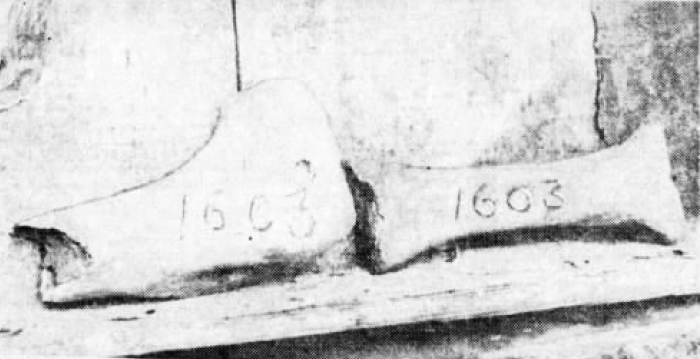
RAY: [MUMBLING] Okay, it says Hurst is a local farmer who was cleaning out some leaves from a local spring, just as he does every fall. While digging out the spring, he saw what he believed was gold dust. He dug deeper and eventually his shovel hit a wooden chest. He was sure he’d found some kind of buried treasure. But when he opened the box, he discovered an arrowhead and broken pieces of two human leg bones with the number 1603 etched into each one.
JEFF: There was also a book in the trunk that dated back to the year 1808. Most people believe the trunk would date back to about that year.
RAY: But why the bones? And why bury it in Gungywamp?
JEFF: All part of the mystery. What was 1603? Who did the bones belong to? Why would someone date the bones? Another layer of high strangeness here at Gungywamp, and that brings us back to today.
[TRANSITION]
JEFF: Today Gungywamp is managed by the Denison Pequotsepos Nature Center. The good news is you can arrange a guided tour of the complex through them. You can walk the site and ask your own questions.
RAY: It’s great that a place like this is still accessible. It’s also pretty well preserved. I guess we’re just continuing the trend of not messing with what was here before. I’m glad it’s protected and preserved.
JEFF: Still, it feels a little weird up here.
RAY: it does!
JEFF: Whether you believe the complex has Celtic roots, Native American, Colonial, or some combination of all of them, Gungywamp is worth seeing and worth questioning.
[OUTTRO]
RAY: Definitely. And that brings us to After the Legend where we take a deeper dive into this week’s story and sometimes veer off course.
JEFF: After the Legend is brought to you by our patreon patrons! Our patrons are the lifeblood of what we do. They get everything first. They get ad-free access to new episodes, access to our entire archive of shows—over 400 episodes. They get bonus episodes and content that no one else gets to hear, and they get to be a bigger part of our community. The only thing missing is you. Please join us at patreon.com/newenglandlegends. It’s just $3 bucks per month, but that goes a long way in helping us with all of our costs.
To see some pictures of Gungywamp by the great Frank Grace, and pictures of the bones found, click on the link in our episode description, or go to our website and click on Episode 443.
America’s Stonehenge in Salem, New Hampshire, comes to mind as the closest comparison. Many other alignment stones. We covered that place in Episode 73
Before we part ways until next time, please hit that subscribe button wherever you get your podcasts. It’s free! And then you won’t miss a minute of the wicked strangeness. Also, if you want to help even more, please post a review for us, share our episodes on your social media, and tell your friends about us. That’s how we grow. And if you’ve got a weird story for us, reach out to us anytime through our website.
We’d like to thank our sponsors, thank you to our patreon patrons, and our theme music is by John Judd.
Until next time remember… the bizarre is closer than you think.